

This month’s Risk Committee update focuses on scoring of the new MFEX and Clearstream Fund Centre fund platforms, plus takeaways from full visits to Egypt and Canada.
New Fund Platform Assessments: MFEX and CFC
Thomas Murray Risk Committee (RC) has, for the first time, scored the new MFEX and Clearstream Fund Centre fund platforms. Although this is the first time both entities have been rated, the RC recently approved scores for their sister companies/ fund platforms.
These platforms were fully assessed and discussed, including all underlying risk components: Asset Safety, Counterparty, Financial, Asset Servicing and Operational risks.
MFEX
Mutual Funds Exchange AB (MFEX) has been part of the Euroclear Group since 2021, but it will be integrated into Euroclear Bank on 1 January 2026.
Euroclear also provides fund services via the FundSettle platform, which is owned by Euroclear SA/NV. By contrast, MFEX is a separate legal entity domiciled in Sweden.
The MFEX scores are based on responses received last month, and while many answers mirror those given for FundSettle, a few minor differences have resulted in slightly lower CR and OR scores.
Please note that both MFEX and FundSettle are integral parts of the rebranded Euroclear FundsPlace offering. Euroclear FundsPlace serves as the single commercial name for the combined funds services.
After a comprehensive review of MFEX, the RC has resolved to assign an overall risk rating of AA-.
Clearstream Fund Centre
Clearstream Fund Centre (CFC) is one of two legal entities delivering fund services within the Clearstream group. Services offered through the Vestima platform are performed by Clearstream Banking Luxembourg, whereas Clearstream Fund Centre is a standalone legal entity with its own licence and credit ratings.
After a comprehensive review of CFC, the RC has decided to assign an overall risk rating of A+.
No onsite visits were carried out for these fund platforms. The assessment was based solely on their questionnaire responses.
Egypt
The Risk Committee has conducted a full review of banks and CSDs in Egypt.
The Egyptian Central Securities Depository (ECSD) has advised that it’s conducting a feasibility study on the implementation of a settlement guarantee fund (SGF) or central counterparty (CCP) for the ECSD market. It has further signed an MoU with a consultancy firm for a DLT system. A working group comprising the Egyptian Exchange (EGX), MCDR, Central Bank of Egypt (CBE), the Financial Regulatory Authority (FRA) and the ECSD has also been formed.
The FRA is working with the EGX to revamp the current short selling and Securities Borrowing and Lending (SBL) regulations. It was advised that the current regulations aren’t working and that they are planning on implementing the quotation model. EGX is liaising with the concerned parties and expects to go-live by the end of 2025. The SBL will be centralised under the Misr Company for Central Clearing, Depository and Registry (MCDR), and only cash and securities will be an eligible form of collateral. There are discussions taking place to connect the SBL programme/systems with the ECSD to include bonds as an eligible form of collateral. Currently, there is no securities borrowing and lending facility for government debt securities in the Egyptian market. Repo deals can be conducted on T-bills and on government bonds.
The ECSD has plans to go live with the new 20022 ISO messaging format in Q1 2026, alongside the CBE.
In addition to the CSDs and market developments, the RC reviewed three sub-custodian providers and confirmed the overall risk grades for all of them. One provider saw an increase in its asset safety risk rating due to enhancements and greater automation in the reconciliation process. Operational risk also improved for two providers as a result of better Recovery Time Objective (RTO) performance and strengthened cyber procedures.
Canada
A research and fact-finding visit to Canada saw a review of three banks, together with infrastructure meetings with the regulator, CSD and exchange.
Canada moved to a T+1 settlement cycle on 27 May 2024, a day before the United States. The change, covering equities, fixed‑income and other asset classes, was intended to reduce market risk, improve operational efficiency and free up capital by shortening the interval between trade execution and settlement. This move proceeded more smoothly than expected, with normal settlement maintained. Any impact was felt more by investors than by the clearing house, as many clients trade ETFs that settle on different cycles in Japan, Europe and other jurisdictions. This lack of harmonisation creates difficulties, as collateral management becomes more complicated. Settlement fail rates did not change significantly after the migration, further indicating that the transition was efficiently managed.
While the transition was largely smooth and the overall trade‑fail rate remained low, it did expose a few pain points: firms with limited automation experienced back‑office strain, international investors faced tighter timelines for trade matching and foreign exchange conversion, and some niche segments - such as certain securities on the Canadian Securities Exchange - saw a slight rise in fails. The faster cycle also compressed securities‑lending recall periods and created timing mismatches for investment vehicles holding both North American and foreign securities. These issues underscored the importance of market‑wide collaboration and greater automation, and most were mitigated through improved planning and process optimisation.
In Q3 2025, the Canadian Depository for Securities (CDS) released a white paper outlining the same challenges and reform agenda described above. The paper confirms that Canada’s corporate‑action (CA) ecosystem - responsible for roughly 245,000 events and CAD 4.7 trillion in payouts each year - still suffers from a cluster of inter‑related problems, including no standard data format or standing‑instruction capability, cross‑border friction, fragmented information, inefficient warrant handling, no systematic removal of worthless securities, and heavy reliance on manual data entry – leaving the market ill‑prepared for the upcoming ISO 20022 transition. The next‑steps in the roadmap are set out in the CDS white paper and the TMX PTI‑led CARWG working group.
The Toronto Stock Exchange (TSX) is working with the government, the Ministry of Finance and regulators, to ensure that policies are in place to encourage additional investment to Canada. One measure already taken is the removal of the quarterly results disclosure requirement for medium and small cap companies listed on the TSX Venture Exchange. That requirement imposed a heavy burden on those issuers (e.g., interim audits and additional compliance costs). These companies now disclose results on a semi-annual basis. This is expected to encourage more medium and small cap firms to list on TSX Venture.
TMX Group is currently integrating the trading engines of its exchanges – the Toronto Stock Exchange, TSX Venture Exchange, TSX Alpha Exchange and the Montreal Exchange (the derivatives market) – which currently run on different platforms. The Group wants to consolidate the platforms to reduce latency and provide a better service for users abroad (especially in Europe and Asia). The new platform will be developed in-house, and the project is expected to begin in Q3 2026, with full integration to be completed on a staggered schedule, beginning with TSX Alpha Exchange (the smallest market).
Regarding sub-custodian banks, the RC reviewed three providers in the market and confirmed the overall grades for all of them. One provider received a slight downgrade in its financial risk rating due to the deterioration of certain financial components.
Austria
Following a review of Austria, asset safety changes have resulted in an update of all ‘naming convention at CSD’ fields to reflect Austrian law whereby sub-custodian omnibus accounts are deemed client asset accounts.
In terms of sub-custodian banks, the RC reviewed five providers. There were no major changes to the overall grades, except for a detailed review of the Asset Safety Risk (ASY) section relating to the Naming Convention at the CSD. The Austrian Custody Act, paragraph 9(2), establishes a legal presumption that when a custodian entrusts securities to a third party in Austria (i.e. OeKB), the third party is deemed to know that the securities do not belong to the custodian, thereby limiting the assertion of lien and retention rights. As a result, the ASY risk was downgraded for a couple of providers.
In addition, a couple of providers received upgrades to their financial risk grades due to improvements in certain risk ratios, stronger financial performance, and upgrades in credit ratings.
Slovak Republic
The RC review of Slovakia saw one bank downgraded on overall risk due to lower FR, asset servicing and operational risk scores. Meanwhile another bank saw an upgrade in overall risk, based onupgrades in asset safety and asset servicing – this resulted from confirmation at the market level, and as recorded in the CSD risk assessment, that they have a right of retention of security and can block movement.
There has also been a correction in proxy voting after receiving confirmation to include that the agent provides limited representation at meetings. Another bank saw an asset servicing upgrade due to similar correction where, for proxy voting, meeting representation now includes limited service, with all available methods and electronic voting now available.
One bank obtained an asset servicing upgrade due to confirmation that they will now assist clients with market claims, if requested, where previously they were not providing any form of support.
Montenegro
Montenegro has launched an OTC platform, which has been very successful. The turnover on that platform is now higher than on the actual exchange. Montenegro has also become a member of a separate single year payment area. Furthermore, the CSD has announced new functionality, including a web portal and the allowance of electronic shareholder annual meetings.

Risk Committee Updates
Stay informed with Thomas Murray for the latest on market dynamics and regulatory trends – subscribe to Risk Committee Updates on LinkedIn.
We safeguard clients and their communities

Petroleum Development Oman Pension Fund
“Thomas Murray has been a very valuable partner in the selection process of our new custodian for Petroleum Development Oman Pension Fund.”
ATHEX
"Thomas Murray now plays a key role in helping us to detect and remediate issues in our security posture, and to quantify ATHEX's security performance to our directors and customers."

Northern Trust
“Thomas Murray provides Northern Trust with a range of RFP products, services and technology, delivering an efficient and cost-effective solution that frees our network managers up to focus on higher Value activities.”
Insights

How Often Should ODD Be Refreshed? A Practical Framework
Most allocators do a full ODD review every 12 to 36 months, but the right cadence depends on risk. Here's a practical five-step framework for deciding how often to review each manager.

Private Equity Has a Cyber Risk Blind Spot
Private equity has become much better at assessing cyber risk, but it may be looking in the wrong place.

What AI Actually Changes About the DDQ (and What It Doesn't)
AI is transforming DDQ workflows, but it doesn't change what a questionnaire actually is: self-reported data. Here's where the line falls, and what to ask before adopting an AI-assisted tool.
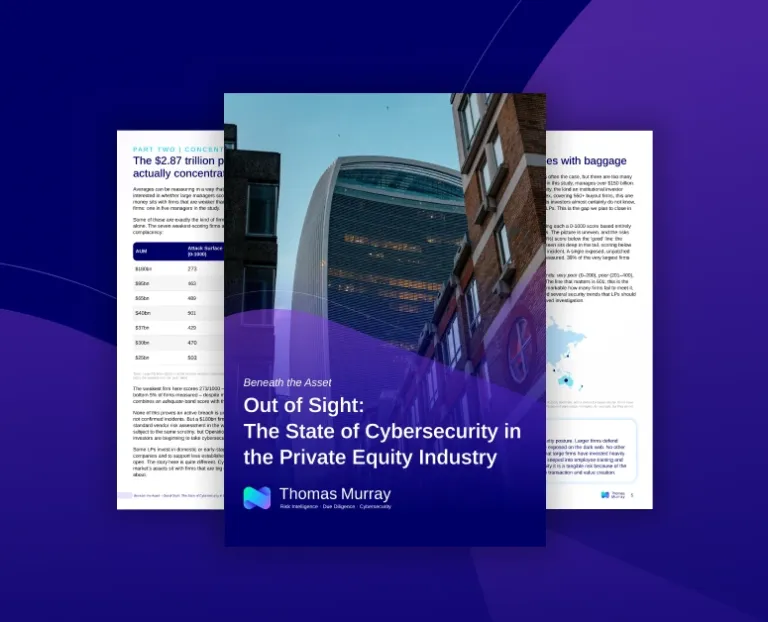
Beneath the Asset – Out of Sight: The State of Cybersecurity in the Private Equity Industry
The UK’s smallest investment funds are weak security link in protecting the IP needed for national growth, new Thomas Murray study finds.