

This month’s Risk Committee newsletter again focuses on the Risk Committee’s assessment of the geopolitical situation in the Middle East and its potential implications for post-trade markets, financial market infrastructures (FMIs), sub-custodian banks, and global custodians operating in the region. We also have updates from our annual due diligence visits to WAEMU, Nigeria, Ghana, and Bangladesh.
Middle East update
On Saturday 28 February 2026, the United States and Israel launched massive strikes against Iran, and the conflict rapidly expanded to include multiple countries.
In the first week of March 2026, there was considerable disruption in the Middle East. Global markets initially saw a significant sell-off, with subsequent gradual stabilisation over the following week. Each market was affected by multiple factors, not least by each country’s direct reliance on Middle East oil supplies. Benchmark crude oil prices have surged since the initial attacks, with Brent crude at its highest levels since January 2025.
Some of the heaviest market losses were seen in Korea, Japan, and Thailand - some of the biggest importers of Gulf oil supplies. For example, Thailand was down 9%, and the Korean KOSPI recorded its biggest daily percentage loss in history on 4 March, falling over 12%. Following the initial plunge, trading volume was extremely heavy on 5 March as individual investors engaged in heavy buying, with 1.6 billion shares changing hands on that day alone. The KRX activated trading limits to suspend program trading multiple times during this period and circuit breakers halted trading temporarily on 4 March.
By contrast, the US market largely shrugged off any impact (initially), with markets looking at the conflict as a temporary inflationary event rather than a long-lasting conflict that will significantly affect global growth and monetary policy.
Critical to that outlook will be how much Gulf production is disrupted and distribution is backed up due to the Strait of Hormuz blockade. Iraq oil production has largely halted, and Saudi Arabia has cut production by 20% to eight million barrels per day, with production in the UAE down by more than half (IEA Member countries unanimously agreed on 11 March to make 400 mb of oil from their emergency reserves available to the market to address disruptions stemming from the war in the Middle East). This situation is already benefiting Russia, as major importers such as India and China look for replacement supplies.
Latest situation
As of 10 April 2026, we can report that all Middle East markets are operating as normal.
It has been advised that the financial institutions, including the stock exchange, the central securities depository (CSD) and the central bank, are currently operating as normal in Bahrain, Egypt, Jordan, Kuwait, Lebanon, Oman, Qatar, Saudi Arabia, and the United Arab Emirates (UAE). The Overall Outlook and Operational Risk for the above markets remains ‘On Watch’ (CSD, MASRA, CMIRA). Meanwhile, UAE Liquidity has now been placed On Watch.
The Central Bank of Bahrain (CBB) issued a press release in March affirming the Kingdom’s banking and financial sector operations and that safety and redundancy measures are in place. The CBB has increased its oversight and is coordinating with banks, insurance companies and financial institutions across the sector to ensure the uninterrupted delivery of financial services. Physical and cybersecurity measures across all financial institutions are operating at the highest levels of readiness.
The Central Bank of Kuwait confirmed on 26 March 2026 that all financial payment systems in the country are operating normally. The central bank is monitoring the developments and stands ready to take necessary precautionary measures to maintain monetary and financial stability in the country if needed.
On 29 March 2026, the Central Bank of Qatar (QCB) announced precautionary measures to support the financial stability and sustain the effective functioning of the markets:
- The QCB will offer an unlimited amount of Qatari Riyal (QAR) repurchase (repo) facilities against eligible securities held by banks.
- A new repo facility, with up to three months maturities, will be added in addition to the current overnight repo facility offered by the QCB.
- The reserve requirements on deposits will be reduced from 4.5% to 3.5%.
- For borrowers affected by the current geopolitical situation, the QCB will permit banks to defer the loan principal and interest payments for a period of up to three months (applied in accordance with the bank's internal policies and supervisory guidance).
The QCB has also mandated all financial institutions operating in the country to implement a hybrid working model with 70% of their workforce required to work remotely until further notice.
The Central Bank of UAE has affirmed that the UAE’s banking and financial sector continues to operate normally. The central bank advised that it is closely monitoring the key indicators of financial stability and liquidity across the banking and financial sector and is conducting regular stress-testing exercises to ensure the continued soundness and resilience of the financial system.
Turkey has not been impacted by the conflict, but regulators have introduced measures like the suspension of short sales and repo transactions and will participate in FX FWD contracts as a preventative measure to address liquidity threats from the conflict. Consequently, Turkey is On Watch for liquidity but not for operational risk.
Geopolitical context
On 2 April, the GCC Secretary-General, Jassim al-Budaiwi, delivered a high-level briefing to the UN Security Council, calling for immediate cessation of Iranian aggressions involving ballistic missiles and armed drones targeting civilian and vital infrastructure across all six GCC states, and urging the Council to guarantee uninterrupted navigation through all strategic waterways.
On 6 April, Al Jazeera published analysis arguing that the existing security architecture built at the expense of a neighbour is no longer viable, and that the GCC and Iran must negotiate a new cooperative framework for the Strait of Hormuz.
In addition, the Houthis have threatened closure of the Bab al-Mandeb Strait, a move that - combined with the Strait of Hormuz blockade - could push the global economy toward depression.
On 6 April, Iran rejected a US proposal for a temporary ceasefire, conveying through Pakistan, a mediator, its demand for a permanent end to the war. This volatile kinetic environment directly sustains the cyber threat to Middle East financial infrastructure.
The IRGC’s 31 March threat listed 18 companies, including Meta, Nvidia, Oracle, Tesla, HP, Intel, IBM, and UAE AI champion G42, advising employees to leave their workplaces immediately, an unprecedented public escalation blurring the line between physical and cyber targeting and elevating risk for any organisation with a digital or physical footprint tied to those firms. This represents an escalation in signalling that blurs cyber and physical targeting thresholds. Any GCC-based organisation with supply chain dependencies, partnerships, or hosting relationships tied to these firms should be considered at elevated risk of both cyber intrusion and collateral targeting.
Financial sector targeting remained low in the first week of April, with only two incidents recorded, a notable reprieve given that prior weeks saw heightened attention to banking and payment systems across the GCC. However, this relative calm is likely misleading. DieNet published structured target lists spanning Qatar, Bahrain, the UAE, Kuwait, and Saudi Arabia, and the IRGC’s 31 March threat list included JPMorgan Chase. Regional hubs, including the UAE, Saudi Arabia, and Qatar face AI-backed phishing, ransomware, and intrusion attempts on banking and payment systems. Financial sector CISOs should treat the current low volume as an operational window to harden defences rather than evidence of reduced risk.
We continue to monitor the situation in the region and will communicate further when changes occur.
Due Diligence visits to WAEMU, Nigeria and Ghana
WAEMU
The West African Economic and Monetary Union (WAEMU) is a treaty-based arrangement binding together eight West African states: Benin, Burkina Faso, Guinea Bissau, Ivory Coast, Mali, Niger, Senegal and Togo.
Our annual due diligence review of banks in the WAEMU area concludes that the outlook remains stable for all area. Notably, there have been increases in earnings performance and capital adequacy / liquidity coverage ratios.
Ghana
Outlooks for Ghana are all stable, with one exception, due to a fine by the Prudential Authority after an inspection in 2022 found issues with monitoring system-generated alerts in 2019 and submitting regulatory reports on time. The bank in question cooperated fully and has since remediated the concerns through a comprehensive programme. The outlook for operational risk here has been set to 'On Watch' due to the above administrative sanctions.
Nigeria
The outlook for Nigeria is stable with one bank On Watch for Ops Risk (re. a fine) and another On Watch for Operational Risk, due to additional fines applied by the Federal Reserve Board and OCC, who have determined that they haven’t made sufficient progress to remediate prolonged deficiencies in their enterprise-wide risk management, compliance risk management, data governance, and internal controls from a 2020 Cease and Desist Order.
Due Diligence visit to Bangladesh
Based on the 2026 due diligence questionnaires submitted by the two banks in Bangladesh, there are no risk grade changes in the country (there is no DDV due this year).

Risk Committee Updates
Stay informed with Thomas Murray for the latest on market dynamics and regulatory trends – subscribe to Risk Committee Updates on LinkedIn.
We safeguard clients and their communities
Petroleum Development Oman Pension Fund
“Thomas Murray has been a very valuable partner in the selection process of our new custodian for Petroleum Development Oman Pension Fund.”
ATHEX
"Thomas Murray now plays a key role in helping us to detect and remediate issues in our security posture, and to quantify ATHEX's security performance to our directors and customers."

Northern Trust
“Thomas Murray provides Northern Trust with a range of RFP products, services and technology, delivering an efficient and cost-effective solution that frees our network managers up to focus on higher Value activities.”
Insights

How Often Should ODD Be Refreshed? A Practical Framework
Most allocators do a full ODD review every 12 to 36 months, but the right cadence depends on risk. Here's a practical five-step framework for deciding how often to review each manager.

Private Equity Has a Cyber Risk Blind Spot
Private equity has become much better at assessing cyber risk, but it may be looking in the wrong place.

What AI Actually Changes About the DDQ (and What It Doesn't)
AI is transforming DDQ workflows, but it doesn't change what a questionnaire actually is: self-reported data. Here's where the line falls, and what to ask before adopting an AI-assisted tool.
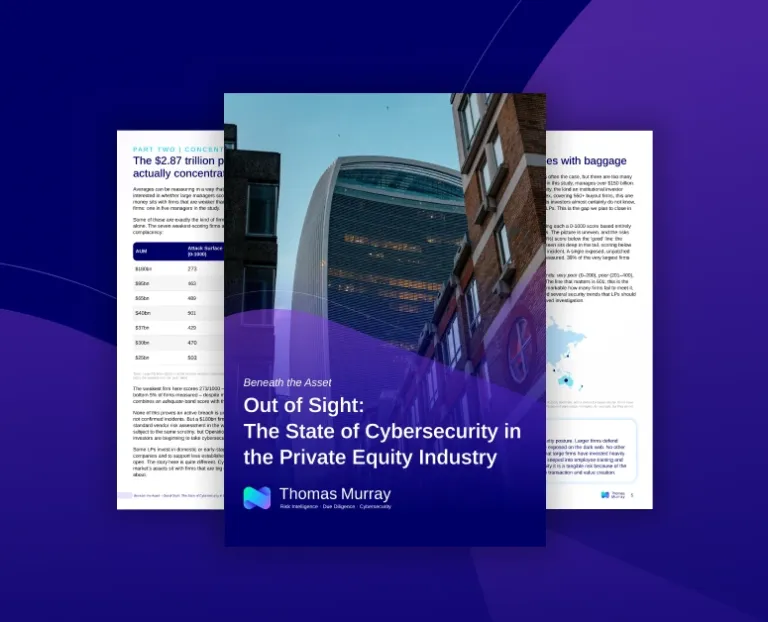
Beneath the Asset – Out of Sight: The State of Cybersecurity in the Private Equity Industry
The UK’s smallest investment funds are weak security link in protecting the IP needed for national growth, new Thomas Murray study finds.