


The Risk
Central counterparties (CCPs) have a systemically important role in resolving many of the issues that triggered the 2007 global financial crises, both in clearing OTC derivatives markets and domestic cash markets. Every CCP has its own way of operating, different margin models, risk waterfalls, financial, ownership and governance models.
- What happens to your collateral contribution in the event of a default?
- What happens to your open positions?
- If a major participant at the CCP goes into default, how quickly does your collateral come under threat?
These questions and others are hugely important for deciding which CCP(s) best fits investor needs. There is huge potential for systemic risk in CCPs and the consequences of failure could be very serious for clearing members, their clients, and the wider market.
The Solution
Thomas Murray has addressed the global regulatory and risk imperative to assess and monitor CCPs as risk concentrating vehicles. CCP Risk Assessments assess the extent to which a CCP manages your risk burden. There are two key benefits:
- Every assessment brings transparency to the industry for the benefit of users
- Using Thomas Murray provides cost savings to regulated firms that are required to perform due diligence and risk assessments on CCPs

Thomas Murray assesses risks at CCPs across six categories:

Counterparty risk
Liquidity
Asset safety
Financial risk
Operational risk
Governance and transparency
We safeguard clients and their communities

Petroleum Development Oman Pension Fund
“Thomas Murray has been a very valuable partner in the selection process of our new custodian for Petroleum Development Oman Pension Fund.”

ATHEX
"Thomas Murray now plays a key role in helping us to detect and remediate issues in our security posture, and to quantify ATHEX's security performance to our directors and customers."

Northern Trust
“Thomas Murray provides Northern Trust with a range of RFP products, services and technology, delivering an efficient and cost-effective solution that frees our network managers up to focus on higher Value activities.”
Insights

Insource, Outsource or Both? Finding Your Place on the ODD Spectrum
Owning the judgement, sharing the workload: a balanced look at insourced, outsourced and hybrid ODD models.
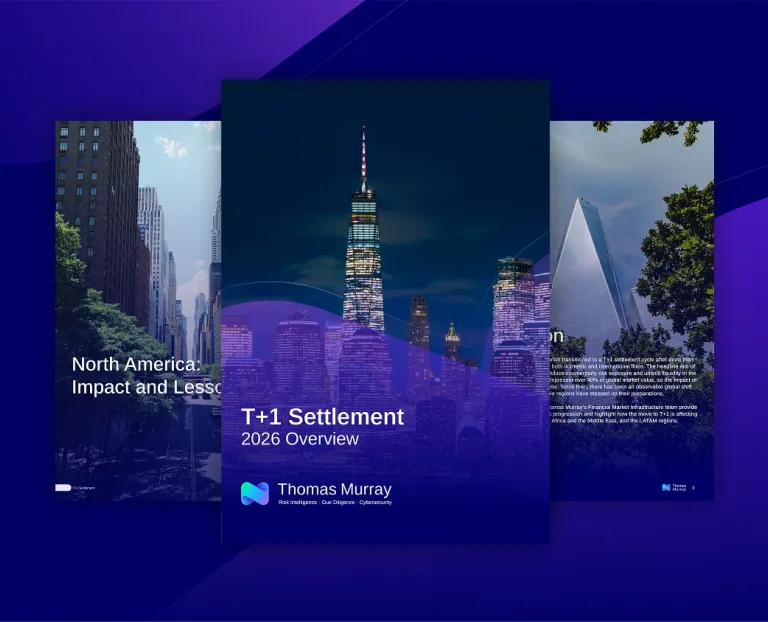
T+1 Settlement: 2026 Autumn Update
Expert analysis from Thomas Murray's Financial Market Infrastructure team of how the move to T+1 is affecting the world's markets.

How Often Should ODD Be Refreshed? A Practical Framework
Most allocators do a full ODD review every 12 to 36 months, but the right cadence depends on risk. Here's a practical five-step framework for deciding how often to review each manager.

Private Equity Has a Cyber Risk Blind Spot
Private equity has become much better at assessing cyber risk, but it may be looking in the wrong place.
Contact us