

Information current as of 26 March 2026
SEC and CFTC Sign MoU on Market Oversight Harmonisation
The Securities and Exchange Commission (SEC) and the Commodity Futures Trading Commission (CFTC) have signed a Memorandum of Understanding (MoU) guiding coordination and collaboration between the two agencies. The aim is to support lawful innovation and market integrity, and to promote investor and customer protection.
Under the MoU, the SEC and CFTC will establish a framework within which the agencies can coordinate regulatory efforts, reduce duplicative regulations, and provide clarity to market participants.
The agencies will seek to:
- Clarify product definitions through joint interpretations.
- Modernise clearing, margin, and collateral frameworks.
- Reduce frictions for dually registered exchanges, trading venues and intermediaries.
- Provide a fit-for-purpose regulatory framework for crypto assets.
- Streamline regulatory reporting for trade data, funds, and intermediaries.
- Coordinate cross-market examinations, risk monitoring, surveillance and enforcement.
The MoU seeks to increase coordination by facilitating regular meetings, data sharing, cross-training of staff and providing advanced notification of areas of regulatory interest.
You can view the text of the MoU here.
SEC Clarifies Application of Federal Securities Law to Crypto Assets
The Securities and Exchange Commission (SEC) have issued an interpretation clarifying how federal securities law applies to certain crypto assets and transactions involving crypto assets.
This is a major step in the Commission’s efforts to provide greater clarity regarding the Commission’s treatment of crypto assets and complements Congressional endeavours to codify a comprehensive market structure framework into statute. The Commodity Futures Trading Commission (CFTC) joined the interpretation to provide guidance that the CFTC and its staff will administer the Commodity Exchange Act consistent with the Commission’s interpretation.
The interpretation seeks to provide greater clarity on the SEC's treatment of crypto assets, particularly the token taxonomy, how non-security crypto assets may become subject to, and cease to be subject to, an investment contract, and the application of federal securities laws to protocol mining, protocol staking, wrapping of non-security crypto assets and airdrops.
Key aspects of the SEC's interpretation include:
- Crypto assets are classified into categories based on their characteristics, uses and functions. Each category has been defined either as a security or not under the federal securities law.
- Digital Securities (or tokenised securities) have been defined as a security. Such financial instruments that are formatted as or represented by a crypto asset, where the record of ownership is maintained in whole, or in part, on or through one or more crypto networks.
- The following categories are not classified as securities:
- Digital Commodities: Crypto assets whose value derives from the programmatic operation of a crypto system and from supply and demand, rather than from the expectation of profits arising from the managerial efforts of others.
- Stablecoins: The Guiding and Establishing National Innovation for US Stablecoins (GENIUS) Act stablecoins, defined as "payment stablecoin issued by a permitted payment stablecoin issuer."
- Non-security crypto assets may become subject to an investment contract when an issuer offers it by inducing an investment of money in a common enterprise with representations or promises to perform essential managerial efforts from which the purchaser would expect to derive profits.
- Non-security crypto assets cease to be subject to an investment contract when the investment contract terminates where either the issuer has fulfilled its representations or promises, or the issuer has failed to satisfy its representations or promises.
- Protocol mining, protocol staking and the wrapping of a non-security crypto asset do not involve the offer and sale of a security.
- Crypto asset disseminations (airdrops) do not involve an investment of money under the Howey test.
“After more than a decade of uncertainty, this interpretation will provide market participants with a clear understanding of how the Commission treats crypto assets under federal securities laws. This is what regulatory agencies are supposed to do: draw clear lines in clear terms,” said SEC Chairman Paul S. Atkins. “It also acknowledges what the former administration refused to recognise – that most crypto assets are not themselves securities. And it reflects the reality that investment contracts can come to an end.”
The official SEC announcements are available here: Press Release, Fact Sheet, and Interpretation.
SEC Approves Nasdaq's Move to Support Tokenised Securities Trading
The US Securities and Exchange Commission (SEC) has approved Nasdaq’s proposal to allow certain securities to trade in tokenised form, marking a significant milestone in integrating blockchain technology into US equity markets.
Nasdaq's tokenisation plan ties into a pilot run by the Depository Trust Company (DTC), which will handle clearing and settlement of tokenised trades. Nasdaq filed for regulatory permission in September 2025.
Under the framework, eligible Nasdaq participants can choose to have trades settled as blockchain-based tokens rather than through standard book-entry systems.
Tokenised shares will trade alongside traditional shares on the same order book and at the same price. They will carry identical rights, use the same ticker and CUSIP (identification number) and follow existing market rules.
The SEC said the structure meets investor protection standards, noting that surveillance, data reporting and settlement timelines remain intact.
The SEC approval can be found here.
Bank of Zambia Announces Development of Regulatory Framework for VASPs
The Bank of Zambia, in collaboration with other regulators and key stakeholders, has begun the development and implementation of a comprehensive regulatory framework for Virtual Asset Service Providers (VASPs) operating in Zambia. The aim of this framework is to mitigate risk to maintain financial system stability, promote innovation and safeguard consumers.
As part of this process, the Bank of Zambia has requested all entities and individuals providing virtual/crypto asset services within Zambia to register with the Bank by 27 March 2026.
This registration applies to both resident and non-resident entities/individuals that offer virtual asset services to individuals and businesses within Zambia, regardless of their physical presence.
Furthermore, registration is required for a natural or legal person who, as a business, conducts one or more of the following activities or operations for or on behalf of another natural or legal person.
- Exchange between virtual assets and fiat currencies.
- Exchange between one or more forms of virtual assets.
- Transfer of virtual assets.
- Safekeeping and/or administration of virtual assets or instruments enabling control over virtual assets.
- Participation in and provision of financial services related to an issuer’s offer and/or sale of a virtual asset.
Bursa Malaysia Issues Consultation Paper on Digital Currency ETFs
Bursa Malaysia has issued a consultation paper seeking public feedback on the proposed rule amendments to facilitate the listing and trading of digital currency Exchange‑Traded Funds (ETFs).
This review follows the Securities Commission Malaysia’s recent revision of the Guidelines on Exchange‑Traded Funds, issued on 2 March 2026, which now permits the offering of digital currency ETFs under an enhanced regulatory framework.
The consultation paper is open to feedback until 10 April 2026 and proposes the following amendments:
- To enhance transparency, specific material information regarding digital currency ETFs must be disclosed in an announcement immediately and in the annual report under the MAIN Market Listing Requirements (MAIN LR).
- Key risks associated with a digital currency ETF shall be announced in a key risk disclosure statement, which must be signed by an investor before investing in a digital currency ETF under the Directives of Bursa Malaysia Securities Berhad (BMS Directives).
FATF Reports on the Risks of oVASPs
The Financial Action Task Force has issued a report highlighting how gaps in the oversight of offshore Virtual Asset Service Providers (oVASPs) are exploited to facilitate large-scale fraud, money laundering, and terrorism financing. The report also presents good practices to detect, license or register and supervise oVASPs, as well as sanction non-compliant ones.
Some of the identified measures for jurisdictions to mitigate risks include:
- Adopt an activity-focused framework for identification, licensing and registration.
- Enforce sanctions for non-compliance with AML/CFT/CPF obligations.
- Create a common understanding and boost cooperation through inter-agency taskforces and public-private partnerships.
- Leverage possible supervisor-to-supervisor channels and FIU-to-FIU links to speed up access to information and coordinate enforcement.
ClearToken Launches Regulated Stablecoin FX Settlement Platform
ClearToken, the FCA-authorised digital financial market infrastructure (FMI) provider, and Canton Network have announced a strategic partnership under which ClearToken will deploy three Daml-based Digital Asset Platforms (DAPs) directly on the Canton Network: ‘CT Register’, ‘CT Pay’ and ‘CT Settle’.
This partnership delivers the first FMI-calibre settlement infrastructure for stablecoin FX and tokenised cash flows on a privacy-enabled institutional blockchain, combining ClearToken’s technology and UK FCA licence, with Canton’s atomic composability architecture.
A description of each DAP can be found below:
- CT Register (Tokenisation): Enables the tokenisation and de-tokenisation of fiat, stablecoins and cryptoassets within for use across CT Pay and CT Settle.
- CT Pay (Payments): Enables payments in fiat, stablecoins and tokenised deposits. CT Pay also serves as the payment leg for DvP settlement orchestrated across platforms that integrate with ClearToken’s infrastructure.
- CT Settle (DvP Settlement): Enables DvP net settlement across, cryptoassets and stablecoins.
Benjamin Santos-Stephens, CEO of ClearToken, said: “CT Register, CT Pay and CT Settle deployed on Canton give institutions the regulated end-to-end settlement stack they need to unlock tokenisation, by providing PvP payment certainty and DvP finality of settlement across every form of digital money.”
Eurosystem Releases Appia Roadmap for Tokenised Finance
The Eurosystem has published the roadmap for Appia, a strategic initiative to shape the development of a European tokenised financial ecosystem in which central bank money continues to play a central role. Targeted for completion in 2028, it will bring together the Eurosystem as well as public and private sector stakeholders, with the aim of building integrated, innovative and resilient tokenised wholesale financial markets in Europe.
By keeping central bank money as the anchor, the initiative seeks to preserve effective monetary policy transmission, financial system stability and the smooth operation of payment systems, while promoting a more unified and competitive European payments and securities market.
“With Appia, we are building a road from today’s financial system to tomorrow’s tokenised markets, firmly grounded in central bank money,” said Piero Cipollone, member of the ECB’s Executive Board.
FDIC Announces Update on Reforms to Regulatory Toolkit
FDIC Chairman Travis Hill has announced a comprehensive effort to reform the agency's regulatory toolkit, with a shift from process-oriented supervision to a focus on material safety, soundness, and compliance. The reforms focus on bolstering regulatory consistency, improving examination efficiency, and managing emerging fintech risks, including restricting pass-through insurance for payment stablecoins.
Hill described reforming supervision as a top priority for the FDIC, and also listed regulatory capital, liquidity, the Bank Secrecy Act (BSA) / Anti-Money Laundering (AML), stablecoins, and shelf charters, as key areas for reform.
KBC Selects Taurus for Crypto Custody as Belgian Bank Launches Retail Trading
KBC, one of Belgium’s leading bank-insurance groups, has selected Taurus as its custody partner for crypto assets. Under the partnership, KBC will leverage Taurus-PROTECT, Taurus’ banking-grade digital asset custody platform, to support its regulated crypto offering.
This partnership supports KBC’s move into regulated crypto services and builds on the bank’s earlier announcement that private investors in Belgium will be able to buy and sell crypto assets through Bolero, KBC’s online platform for self-directed investors. With this initiative, KBC becomes the first Belgian bank to offer crypto trading within a fully regulated banking framework.
At launch, the offering will cover Bitcoin and Ether and will operate on an execution-only basis for self-directed investors. Crypto trading will be conducted in line with applicable European regulation, including the MiCAR framework, and will be accompanied by mandatory risk disclosures and investor education.
PayPal Brings Stablecoin to 70 Markets
PayPal has announced that it’s making PayPal USD (PYUSD) available in 70 markets worldwidein the PayPal account. This dollar-backed stablecoin enables users to send funds globally, with faster settlement and lower cost than traditional payment methods.
Users in newly supported markets can buy, hold, send, and receive PYUSD directly from their PayPal account. Additionally, eligible users can earn rewards on their PYUSD holdings, can instantly transfer funds to friends and family, whether on PayPal or to third-party digital wallets, and can convert PYUSD to local currency when withdrawing funds for everyday spending.
Businesses that accept PYUSD can use proceeds in minutes rather than days or weeks, improving liquidity and reducing reliance on traditional settlement cycles. Faster access to funds can help businesses manage working capital, support cross-border operations, and participate in global commerce.
May Zabaneh, Senior Vice President and General Manager of Crypto, PayPal said: "Enabling PYUSD in users' accounts across 70 markets gives people faster access to their funds, lower-cost ways to send money across borders, and a more direct path to participating in the global economy, and that is what drives commerce forward for everyone."
US Senate Bans the Digital Dollar
The US Senate has passed a bill containing a ban on the development of an American CBDC, often referred to as the “digital dollar”.
The ban on an American CBDC, or central bank digital currency, would last until 2031. It was added to a sweeping housing bill otherwise unrelated to crypto, referred to as the 21st Century ROAD to Housing Act, that places limits on the number of homes that private equity firms and other large investors can own.
Despite the Senate’s approved of the bill in a bipartisan, 89-10 vote, it still faces obstacles, including signals from House lawmakers that they will force a rewrite of the legislation.

Digital Asset Custodian Monitoring
Our DACM solution sets a standard for transparency and risk intelligence in digital markets. Against an industry that is complex, fragmented, unstandardised, and fraught with cyber risk, our solution provides you with the tools and insights to effectively evaluate, select and monitor your digital asset custodian.
Insights

Financial Statement Red Flags: An Operational Due Diligence Perspective
Audited financial statements are one of the richest, most under-used sources of insight into a manager's financial health. Here's what actually predicts stress, and how financial analysis fits within a broader operational due diligence framework.

Why Summer is a Blind Spot in Private Equity Risk Oversight
Threat levels don't take annual leave. Why PE firms need continuous cyber oversight of portfolio companies, not seasonal assessment.

Why Cyber Risk Belongs in Operational Due Diligence
Cyber risk is still treated as an IT checkbox in operational due diligence. Here's why it needs to be a continuous monitoring signal.
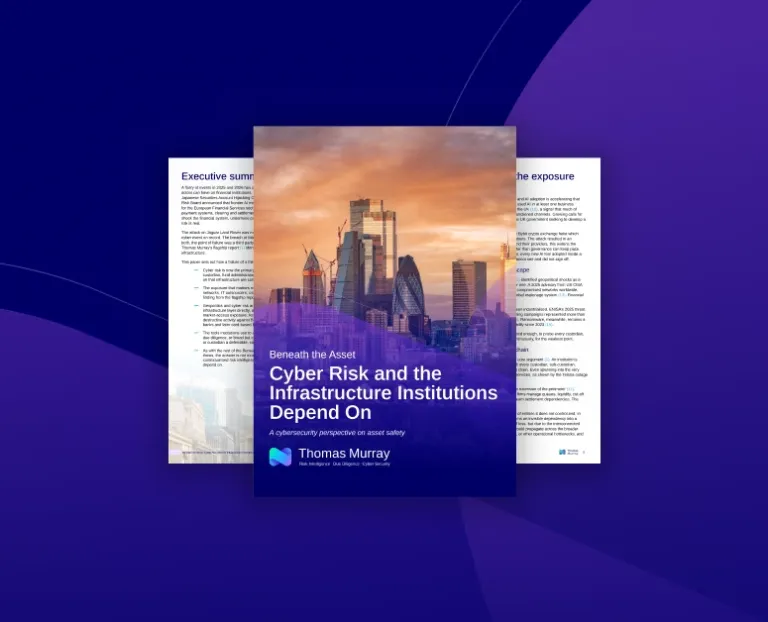
Thomas Murray Publishes "Beneath the Asset: Cyber Risk and the Infrastructure Institutions Depend On"
Cyber risk has become the primary mechanism through which infrastructure failures reach institutional assets