

This newsletter serves as a curated newsfeed of information relevant to the institutional community, as it navigates the proliferation of digital assets and distributed ledger technology. It is shaped using Thomas Murray's Digital Asset Market Information (DAMI), which provides asset owners, managers, intermediaries and VASPs with the regulatory clarity they need to operate confidently across digital asset markets. Currently covering 18 key jurisdictions and tracking over 100 markets in real time, Thomas Murray applies a consistent approach across ten dimensions, from regulation, asset classification and licensing to digital payment developments, taxation and custody frameworks, enabling fast, structured cross-jurisdictional comparison for strategic decision-making and risk management.
Information current as of 20 August 2026
Tokenised stocks continue to take centre stage this week. Crypto.com has launched exposure to 1,500 United States equities and Exchange-Traded Funds across the European Economic Area, while Coinbase has planted its flag in Abu Dhabi as its international tokenisation hub. Both moves reflect a broader race to build regulated distribution infrastructure for tokenised equities across Europe and the Middle East, and neither is likely to be the last. On the regulatory side, Circle has picked up a trust charter in New York, Copper has established a qualified custodian presence in the United States, and the United Kingdom's Crypto All-Party Parliamentary Group has raised the alarm over banking access for the sector. We also cover Broadridge's Distributed Ledger Repo platform hitting a new volume milestone, and partnerships from BNY, Taurus, and Northern Trust.
Thomas Murray Newsflashes
Russia
Central Bank of Russia Issues Draft Rules for Margin Trading of Cryptocurrencies
On 29 July 2026, the Central Bank of Russia (CBR) published a draft regulation establishing rules for accepting cryptocurrencies and digital rights as margin collateral and executing short sales. Both qualified and non-qualified investors will be able to participate in margin trading, with cryptocurrency transactions for non-qualified investors subject to limits set by the CBR. The regulation marks a further step in Russia's evolving framework for digital asset market participation, extending established margining concepts into the crypto asset space within a supervised structure.
The official announcement is available here: Central Bank of Russia
Nigeria
Nigeria Revenue Service Publishes Guidelines on the Taxation of Virtual Assets
The Nigeria Revenue Service (NRS) has published Guidelines on the Taxation of Virtual Assets, providing a standardised framework for the tax administration of virtual assets and virtual asset transactions. The Guidelines apply to anyone who acquires, disposes of, exchanges, or deals in virtual assets; receives income in the form of virtual assets; operates as a Virtual Asset Service Provider (VASP) or peer-to-peer marketplace; or provides services relating to virtual assets. Virtual assets are classified into six categories; cryptocurrencies and exchange tokens, stablecoins and payment tokens, security and investment tokens, utility and governance tokens, Non-Fungible Tokens (NFTs), and sovereign digital currency, each with its own tax treatment. Key points include income tax on gains from disposal across most categories; stamp duty on eligible token transfers; staking rewards, Decentralised Finance (DeFi) yield, and liquidity rewards taxable as income; and tokenised Nigerian stocks and shares exempt under Section 184(h) of the Nigeria Tax Act 2025. Sovereign digital currencies including Central Bank Digital Currencies (CBDCs) are treated as fiat and carry no virtual asset tax obligations. The conversion of Nigerian Naira into virtual assets for cross-border settlement does not constitute a taxable disposal.
Guidelines on the Taxation of Virtual Assets Nigeria Revenue Service
South Africa
National Treasury and South African Reserve Bank Issue Draft Crypto Asset Manual for Cross-Border Activities
The National Treasury and the South African Reserve Bank (SARB) have issued the draft Crypto Asset Manual for Cross-Border Activities for public comment, designed to complement the draft Capital Flow Management Regulations 2026 and strengthen oversight of cross-border crypto asset flows. Authorised Crypto Asset Service Providers (CASPs) are classified into three categories: Category One (remittance transactions using crypto assets as a settlement medium); Category Two (cross-border crypto asset transactions); and Category Three (a combination of both). A crypto asset transaction is deemed an import or export of capital at the point of transfer between a domestic authorised CASP and an offshore CASP, or from a domestic authorised CASP to a non-custodial wallet. Key compliance requirements include: client onboarding in line with the Financial Intelligence Centre (FIC) Act; a prohibition on transacting with residents of the Common Monetary Area (CMA); maintenance of a minimum unimpaired capital amount, the higher of South African Rand (ZAR) 5 million or 15% of average positive annual gross income over the preceding three years held in a segregated ZAR-denominated account; and detailed transaction record-keeping reported to the Financial Surveillance Department via the FinSurv Reporting System. The SARB is accepting feedback until 30 September 2026.
The official announcement is available here: South African Reserve Bank
Indonesia
Indonesian Financial Services Authority Issues Draft Regulation on Tokenised Asset Offerings
Indonesia's Financial Services Authority (Otoritas Jasa Keuangan - OJK) has issued a draft regulatory framework governing the issuance, offering, custody, trading, and reporting of Indonesian tokenised assets, and has invited market participants to submit comments. The framework covers Tokenised Asset Issuers, Digital Asset Traders, Real Asset Custodians, Digital Asset Custodians, Clearing Guarantee and Settlement Institutions, Investor and Token Holders, and existing tokenisation platforms and registered tokenised asset providers. Excluded from scope are capital market securities, Central Bank Digital Currencies (CBDCs), utility tokens, Non-Fungible Tokens (NFTs) and other unique non-fungible assets, and airdrops, mining, and staking rewards. The draft regulation is currently available in Indonesian.
Source: OJK
External News:
Regulation
USA
Copper Establishes Regulated United States Presence as a Qualified Custodian and Financial Industry Regulatory Authority Member
Copper's United States entity, Copper Markets (US) Inc., has been accepted as a member of the Financial Industry Regulatory Authority (FINRA) and established as a Qualified Custodian in the United States market, following its registration as a broker-dealer with the Securities and Exchange Commission (SEC). The firm will offer qualified custody, staking, financing, and over-the-counter (OTC) services, as well as access to the ClearLoop Network, Copper's custodian-agnostic collateral mobility platform connecting derivative counterparties for pledging and moving crypto and tokenised assets. The broker-dealer registration is a deliberate structural choice: it positions Copper in regulated capital markets infrastructure rather than in cryptocurrency trading alone, enabling participation in tokenised securities activity and institutional financial services. Copper also holds regulatory registrations in Switzerland, Liechtenstein, and the United Arab Emirates.
UAE
Coinbase Establishes International Tokenisation Hub in Abu Dhabi with Financial Services Permission from the Financial Services Regulatory Authority
Coinbase has received Financial Services Permission (FSP) from the Financial Services Regulatory Authority (FSRA) of Abu Dhabi Global Market (ADGM), establishing its international tokenisation hub in the emirate. The permission covers arranging deals in investments and providing custody to facilitate the launch of tokenised securities, instruments fully backed by underlying shares, with verified token holders receiving full shareholder rights including dividends and voting, subject to vesting conditions set out in each prospectus. The launch sits within a broader United Arab Emirates strategy that includes a separate global derivatives hub in Dubai. Coinbase's position that tokenised equities can function simultaneously as securities, blockchain-native tokens, and Decentralised Finance (DeFi)-composable assets represents one of the more ambitious frameworks yet proposed for the asset class.
USA
Circle Granted Limited Purpose Trust Charter by New York Department of Financial Services
Circle Internet Group has received a limited purpose trust charter from the New York Department of Financial Services (NYDFS) for Circle Internet Trust Company LLC, trading as Circle New York Trust. The charter deepens Circle's regulatory foundation in New York, where it has held a BitLicense since 2015 and places USD Coin (USDC) within a trust company framework as digital dollars become more central to global financial infrastructure. Circle described the charter as a longstanding objective, given the international standard-setting reputation of NYDFS in digital asset regulation.
UK
United Kingdom Crypto All-Party Parliamentary Group Warns Banking Access Gaps Could Derail Incoming Crypto Regime
The United Kingdom's Crypto All-Party Parliamentary Group (APPG) has warned that limited access to banking services for cryptoasset firms could undermine the credibility and commercial viability of the incoming Financial Conduct Authority (FCA) cryptoasset regime. Major United Kingdom banks were questioned over their approach to onboarding cryptoasset businesses, with the group raising concerns that de-banking practices where banks decline or close accounts for crypto firms without clear justification, risk creating a structural barrier to market entry at precisely the moment the United Kingdom is seeking to position itself as a leading jurisdiction for regulated digital asset activity.
Products/Pilots
EUROPE
Crypto.com Launches Tokenised United States Equities and Exchange-Traded Funds Across Europe
Crypto.com has launched Tokenised Stocks across the European Economic Area (EEA) and other approved jurisdictions, giving eligible users exposure to 1,500 underlying United States equities and Exchange-Traded Funds (ETFs) through its app. The instruments are derivative financial products designed to track price performance of the underlying assets. They do not confer legal or beneficial ownership or shareholder rights. In the EEA, Tokenised Stocks are issued by Foris Capital CY Limited, regulated by the Cyprus Securities and Exchange Commission, with underlying assets held in custody with Alpaca, a United States regulated self-clearing broker-dealer. The product offers round-the-clock trading, fractional investing, and fast settlement. The launch follows a $400 million strategic investment from Citadel Securities announced in July, which valued Crypto.com at $20 billion.
BRAZIL
Itaú Unibanco Joins Brazilian Tokenisation Pilot Run by the Brazilian Financial and Capital Markets Association
Itaú Unibanco, the largest bank in Latin America, has joined a tokenisation pilot run by ANBIMA, the Brazilian Financial and Capital Markets Association (Associação Brasileira das Entidades dos Mercados Financeiro e de Capitais), in partnership with digital asset infrastructure provider OpenAssets. The pilot tests the issuance, trading, and settlement of fixed-income securities and investment funds using Distributed Ledger Technology (DLT) on a private, permissioned network. Itaú Unibanco contributes capital markets expertise while OpenAssets provides tokenisation infrastructure, with the partnership developing technical proofs of concept to assess compliance and operational requirements. The initiative comes as the global market for tokenised real-world assets has more than doubled over the past year, from approximately $18.9 billion in August 2025 to over $38 billion currently.
Partnerships/Ecosystem
USA
BNY and Galaxy Collaborate to Advance Digital Asset Infrastructure
BNY has announced a strategic collaboration with Galaxy to integrate staking capabilities into BNY's Digital Asset Custody platform, bringing custody and staking together within a single institutional servicing model for the first time. Galaxy, already a client of BNY's custody platform, will also serve as a design partner on broader platform infrastructure development. The combination targets growing institutional demand for yield-generating strategies on custodied digital assets, delivered within BNY's governance and operational resilience framework. BNY oversees $62.6 trillion in assets under custody and administration as of 30 June 2026. The staking offering remains subject to regulatory review.
EUROPE
Taurus Gives Banks Full Access to Hedera Network Through Single Platform
Swiss digital asset infrastructure provider Taurus, whose platform is used in production by more than 40 banks and regulated financial institutions worldwide including Deutsche Bank, CACEIS, and State Street, has completed full integration of the Hedera network technology stack. Banks can now access the complete range of Hedera capabilities; custody and staking of HBAR (Hedera's native currency), native token issuance through the Hedera Token Service, and smart contract deployment through Hedera's Ethereum Virtual Machine (EVM)-compatible Smart Contract Service through a single platform and under a single due-diligence and risk framework. The integration, delivered across Taurus's three platforms (Taurus-PROTECT, Taurus-EXPLORER, and Taurus-CAPITAL) over 18 months in partnership with The Hashgraph Association, means expanding into new digital asset products becomes a configuration decision rather than a fresh procurement and integration exercise.
USA
Northern Trust Engages Lukka to Enhance Digital Asset Data and Reporting Capabilities
Northern Trust has entered into an agreement with Lukka to deliver institutional-grade digital asset reporting, with connectivity across 100+ blockchains and 400+ centralised exchange (CEX) and decentralised exchange (DEX) sources, alongside custodians, over-the-counter desks, and on-chain activity. The capability provides clients with enhanced reporting on transaction history and point-in-time balances with historical views. Lukka operates under American Institute of Certified Public Accountants (AICPA) SOC 1 Type II and SOC 2 Type II frameworks. Northern Trust manages $20.0 trillion in assets under custody and administration as of 30 June 2026, and the agreement reflects its broader strategy of integrating digital and traditional asset reporting within a unified servicing model.
Markets
USA
Broadridge's Distributed Ledger Repo Platform Hits $365 Billion Average Daily Volume for July
Broadridge's Distributed Ledger Repo (DLR) platform processed $365 billion in average daily trade volume during July, with total monthly volumes reaching $8.0 trillion, a 28% year-on-year increase. The platform enables institutions to settle repo transactions on Distributed Ledger Technology (DLT) while operating within their existing trading and post-trade environments. The figures mark a steady progression from the $362 billion average daily volume recorded in May and reinforce the case that tokenised settlement in the repo market has moved well beyond pilot phase.


Digital Asset Custodian Monitoring
Our DACM solution sets a standard for transparency and risk intelligence in digital markets. Against an industry that is complex, fragmented, unstandardised, and fraught with cyber risk, our solution provides you with the tools and insights to effectively evaluate, select and monitor your digital asset custodian.
Insights

How Often Should ODD Be Refreshed? A Practical Framework
Most allocators do a full ODD review every 12 to 36 months, but the right cadence depends on risk. Here's a practical five-step framework for deciding how often to review each manager.

Private Equity Has a Cyber Risk Blind Spot
Private equity has become much better at assessing cyber risk, but it may be looking in the wrong place.

What AI Actually Changes About the DDQ (and What It Doesn't)
AI is transforming DDQ workflows, but it doesn't change what a questionnaire actually is: self-reported data. Here's where the line falls, and what to ask before adopting an AI-assisted tool.
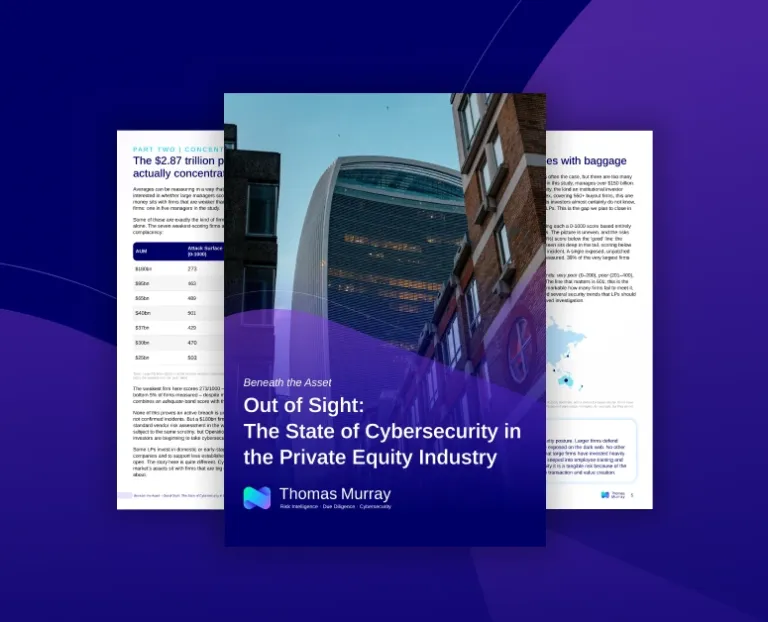
Beneath the Asset – Out of Sight: The State of Cybersecurity in the Private Equity Industry
The UK’s smallest investment funds are weak security link in protecting the IP needed for national growth, new Thomas Murray study finds.