

Information current as of 8 January 2026
The OECD’s CARF Global Crypto Tax Reporting Regime Activates Across 48 Countries
As of 1 January 2026, cryptoasset service providers and the users of their services are now required to provide visibility of transactions and report in scope transactions on an annual basis.
Led by the OECD, with the aim of achieving global tax transparency, the Crypto-Asset Reporting Framework (CARF) requires Crypto-Asset Service Providers (CASPs) like exchanges, custodians, and wallet providers to report user transaction data, such as sales, exchanges, and transfers to tax authorities.
As one of 48 jurisdictions that have pledged to undertake the first exchanges by 2027, the UK Government has suggested that the "new reporting requirements will make it more difficult for taxpayers to avoid reporting under the Common Reporting Standard (CRS), which allows tax authorities to exchange information about financial accounts, by moving their money into cryptoassets."
Brazilian Stock Exchange B3 to Launch its Own Tokenisation Platform and Stablecoin
Brazil’s main stock exchange, B3, is planning on deepening its involvement in the cryptocurrency space through the launch of a tokenisation platform and its own stablecoin in 2026.
The tokenisation platform is set to allow assets to be tokenised and traded on the exchange, with Luiz Masagão, B3’s vice president of products and clients, indicating that both systems will share the same liquidity pool. Meanwhile, the stablecoin will facilitate tokenised asset transactions and is expected to be linked to the Brazilian real.
B3 is also expanding its crypto derivatives offerings, including new options and contracts tied to crypto prices.
BitGo Secures OCC Approval to Convert to a Federally Chartered National Trust Bank
BitGo has received approval from the Office of the Comptroller of the Currency (OCC) to convert BitGo Trust Company, Inc., a South Dakota-chartered trust company, to a national bank named BitGo Bank & Trust, National Association (N.A.).
As a federally chartered bank for digital assets, BitGo will operate under a single, uniform federal supervisory regime, enabling it to deliver the clarity, governance, and regulatory certainty institutions expect from a federally regulated fiduciary.
Under the national bank charter, and subject to applicable law and OCC requirements, BitGo Bank & Trust, N.A. is authorised to offer:
- Custody and safekeeping of digital assets and certain non-deposit financial assets under federal fiduciary and non-fiduciary authorities; and
- Nationwide delivery of certain digital asset–related services, without state-by-state licensing requirements where federal law preempts duplicative obligations.
Philippines Blocks Coinbase and Gemini in Crackdown on Unlicensed Crypto Exchanges
Regulators in the Philippines have ordered internet service providers (ISPs) to block access to Coinbase and Gemini as part of a broader crackdown on unlicensed virtual asset service providers.
This enforcement action reflects the government's move toward stricter regulation of cryptocurrency exchanges, requiring them to obtain local licenses to operate legally. The blocking of these platforms poses significant operational risks for Coinbase and Gemini in the Philippines.
Update on FSTB and SFC Consultation on Digital Asset Custody Legislation
The Financial Services and the Treasury Bureau (FSTB) and the Securities and Futures Commission (SFC) of Hong Kong have published consultation conclusions on legislative proposals to regulate virtual asset (VA) dealing and custodian service providers in the special administrative region. The new regimes are a key step in completing Hong Kong's regulatory framework to support a robust and secure VA ecosystem under the SFC's ASPIRe roadmap.
At the same time, a further public consultation has been issued on the Legislative Proposal to Regulate Virtual Asset Advisory Service Providers and Virtual Asset Management Service Providers. Following the results of the new consultation, the FSTB and SFC will finalise legislative proposals for establishing the licensing regimes for VA dealing, VA advisory and VA management service providers under the AMLO to introduce the bill to the Legislative Council in 2026.
J.P. Morgan Launches Tokenised Money Market Fund
J.P. Morgan Asset Management has launched its first tokenised money market fund, My OnChain Net Yield Fund (“MONY”), on the public Ethereum blockchain, making it the largest GSIB (global systemically important bank) to launch a tokenised money market fund on a public blockchain.
Qualified investors can now access MONY exclusively through the Morgan Money platform, receiving tokens at their blockchain addresses. Morgan Money is the first institutional liquidity trading platform to integrate traditional and on-chain assets, offering investors access to a full-range of money market products.
John Donohue, Head of Global Liquidity at J.P. Morgan Asset Management said: “We are excited to be a first mover with the launch of MONY, and we expect other GSIB banks to follow our lead in providing clients with greater optionality in how they invest in money market funds. With Morgan Money, tokenisation can fundamentally change the speed and efficiency of transactions, adding new capabilities to traditional products. This marks a significant step forward in how assets will be traded in the future.”
Russia Clears Digital Ruble for Immediate Government Use
Originally scheduled for rollout on 1 July 2025, the launch of Russia’s retail central bank digital currency (CBCD) was then postponed until 1 September 2026. However, federal government departments can now use the digital ruble (beginning 1 January 2026), with the Ministry of Finance defining the types of permitted payments in December 2025.
The CBDC can potentially be used for social security payouts, government salary payments, and capital expenditure and maintenance for government properties. The digital ruble will be offered as a payment option, meaning it is up to the recipient to choose how they would like to be paid.

Digital Asset Custodian Monitoring
Our DACM solution sets a standard for transparency and risk intelligence in digital markets. Against an industry that is complex, fragmented, unstandardised, and fraught with cyber risk, our solution provides you with the tools and insights to effectively evaluate, select and monitor your digital asset custodian.
Insights

Why Cyber Risk Belongs in Operational Due Diligence
Cyber risk is still treated as an IT checkbox in operational due diligence. Here's why it needs to be a continuous monitoring signal.
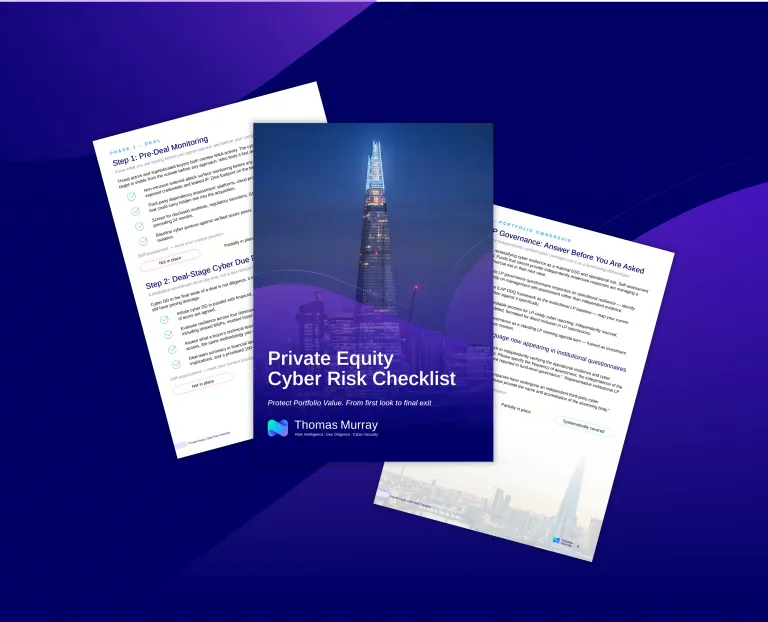
Private Equity Cyber Risk Checklist
The PE Cyber Risk Checklist is a ten-step diagnostic for PE fund leadership, covering every stage from pre-deal surveillance to exit readiness.

Why Private Equity Has Underinvested in Asset Safety, and Why the Window Is Closing
Half of PE portfolio companies carry elevated cybersecurity risk. Here's why asset safety has been underinvested, and why that's changing fast.

ODD Is More Than Questionnaires
Most investors and allocators would struggle to name the last time a due diligence questionnaire predicted a fund manager's operational failure.