

Information current as of 30 April 2026
BIS Warns Crypto Giants to Act Like Banks
The Bank for International Settlements (BIS) has said that the largest crypto platforms must now act like banks and prime brokers, stating that they currently take deposit-like funds without having to adhere to comparable prudential rules (including AML/CFT-related requirements), creating crypto shadow banking risks.
The BIS’ new Financial Stability Institute (FSI) paper describes the largest crypto service providers as "multifunction cryptoasset intermediaries" arguing that these firms need capital, liquidity, governance, and stress testing rules similar to those of regulated banks.
The full paper, From cash to crypto: towards a consistent regulatory approach to illicit payments, can be found here.
UK Announces Payments Rules Covering Stablecoins and Tokenised Deposits
HM Treasury has announced a regulatory package to consolidate stablecoins and tokenised deposits into a single framework alongside traditional payment services.
The announcement came during Fintech Week in London, and is part of a wider plan to modernise payment services regulation and update it to support new innovations in money and payments ahead of an upcoming consultation inviting the payments sector to feed back.
The package proposes new legislation to reduce the administrative requirements for firms looking to provide stablecoin payment services, and gives the FCA expanded regulatory powers over open banking.
Chris Woolard CBE (a partner at EY and former interim CEO of the FCA) has also been announced as the government’s new Wholesale Digital Markets Champion. He will lead the government’s work to deliver a more efficient and competitive financial sector by building a tokenised wholesale financial markets system.
HM Treasury Publishes Draft SI Amending FSMA 2000 (Cryptoassets) Regulations 2026
HM Treasury has published a draft statutory instrument (SI) amending the Financial Services and Markets Act (FSMA) 2000 (Cryptoassets) Regulations 2026 and an accompanying policy note detailing the main provisions introduced by the draft SI and future policy intent.
This draft SI contains proposed amendments to the initial February 2026 legislation aimed at providing greater certainty for firms seeking to provide stablecoins payments services with UK qualifying stablecoins (UKQS), and removing barriers to certain other use cases. It also contains additional changes for the purposes of ensuring an internationally competitive UK regime for cryptoassets.
Once these regulations come into force in October 2027, they will require firms carrying on the new regulated activities to be authorised by the FCA.
Coinbase Lists First GBP Stablecoin
Coinbase has announced that it is listing a new fiat-backed stablecoin, tGBP, stating that expanding access to local currency stablecoins is crucial to positioning the UK as a true global hub for crypto innovation and supports their mission to build a more open, accessible and efficient financial system.
By utilising a GBP-backed stablecoin, users can:
- Reduce friction: Move money instantly without the traditional delays of legacy banking systems.
- Avoid FX volatility: Manage digital assets without the need to constantly convert between USD-pegged stablecoins and British pounds, eliminating unnecessary foreign exchange risks.
- Unlock innovation: Participate in the burgeoning world of tokenised real-world assets and on-chain economy using their local currency.
ASIC Issues Roadmap for Digital Assets Law Reform Implementation
The Australian Securities and Investment Commission (ASIC) has announced a roadmap for the implementation of the Corporations Amendment (Digital Assets Framework) Act 2026 (DAF Act). The DAF Act, which comes into effect on 9 April 2027, provides for an 18-month implementation timeline as follows:
Months 1-6
- Conduct stakeholder roundtables and discussions; establish an industry advisory group.
- Consultation with the industry on regulatory guidance and operational standards (to be set out in legislative instruments).
- Access to the INFO 225 sector-wide class no-action position will expire in June. Entities will need to comply with existing licensing requirements throughout the implementation of the law reforms.
Months 6-12
- Release of new Regulatory Guide for digital asset platforms (DAPs) and tokenised custody platforms (TCPs), covering how the new law operates and who is likely to require a licence under the regime.
- Creation of regulatory instruments setting standards for the operators of DAPs and TCPs, including asset-holding standards, transactional and settlement standards, and financial requirements.
Months 12-18
- DAP and TCP operators will be able to lodge financial service licence applications and operate under regulatory relief until their applications are processed.
October 2027 onwards
- Full implementation of the new digital assets regime, including ASIC supervision and enforcement.
A link to the official ASIC announcement can be found here.
DTCC Advances Cloud First Strategy to Modernise Core Market and Digital Market Infrastructures
The Depository Trust & Clearing Corporation (DTCC) has announced the expansion of its cloud first strategy to modernise its core post-trade and digital market infrastructures through the use of public cloud services (including partnerships with public cloud providers, AWS and Microsoft). The migration follows a Notice of No Objection, issued by the SEC in June 2025, permitting DTCC's clearing agency subsidiaries to move specified core services to a public cloud environment.
A defined set of core applications, supporting clearance settlement and risk management functions, will be incrementally migrated to public cloud infrastructure. These services support its clearing agency subsidiaries, namely the NSCC, FICC and the DTC.
In parallel with the re-architecture of these systems, the DTCC is expanding its digital market infrastructure through its DTCC Digital Assets business, in collaboration with a cloud provider, seeking to cover all digital asset initiatives.
The DTCC press release can be found here.
Tether Freezes $344 Million in USDT on Tron After Intervention by US Authorities
Stablecoin issuer Tether has said it supported the freeze of more than $344 million in USDT across two Tron addresses after US authorities flagged the wallets for illicit activity.
The firm said the freeze was carried out in coordination with the Office of Foreign Assets Control (OFAC) and US law enforcement after authorities shared information tied to unlawful conduct.
Tether said the action followed information linked to sanctions evasion, criminal networks, or other illicit activity, with CEO Paolo Ardoino stating that "USDT is not a safe haven for illicit activity." Ardoino added that Tether moves quickly when it identifies credible links to sanctioned entities or criminal actors.
Tether’s full response can be found here.
OSL and Circle Announce Partnership to Expand Access to USDC in Global Markets
Global stablecoin payment and trading platform, OSL Group, has announced a partnership with Circle, one of the world’s leading financial platform companies, to expand access to USDC across OSL’s trading and payments platforms.
Through OSL Global, OSL’s international trading platform, users can access USD and USDC conversions on a 1:1 basis. The platform also offers "Pro Trading" (orderbook function) within a dedicated USDC trading zone, featuring five major pairs: BTC, ETH, SOL, USD and USDT.
In addition, OSL has used USDC as a unified margin asset on OSL Global to enhance capital efficiency and trading flexibility for eligible clients. OSL’s payment business has also integrated USDC to support digital dollar settlement and payment use cases.
OSL Global will also support access to Circle’s USYC, one of the world’s leading Tokenised Money Market Funds (TMMFs), subject to applicable regulatory requirements and platform eligibility.
The press release can be found here.
Russia Advances Sweeping Crypto Bill With Provisions for 'Circumventing Sanctions'
Russia's parliament has passed a comprehensive crypto regulation bill at its first reading, establishing the country's first formal framework for digital asset regulation while maintaining restrictions on domestic cryptocurrency payments.
This legislation would classify cryptocurrency as property, giving it legal protection in court proceedings, including bankruptcy and divorce cases. Non-qualified investors would face annual purchase limits of 300,000 rubles (around $3,900), while professional participants would not face these restrictions.
Kaplan Panesh, deputy chairman of the State Duma Committee on Budget and Taxes, noted that the bill “allows Russian companies to use cryptocurrency to pay foreign counterparties, circumventing sanctions restrictions."
Ripple Aims for Post-Quantum Readiness on the XRP Ledger
Citing recent research from Google Quantum AI, showing that the cryptography most blockchains rely on today can be broken by sufficiently advanced quantum computers, Ripple has said that it needs to guard against the quantum threat with a plan that treats the required migration as an "architectural challenge touching performance, storage, usability, cryptography, and protocol design."
Their plan is as follows:
- Ripple is introducing a multi-phase roadmap to prepare the XRP Ledger (XRPL) for a post-quantum future, with a target for full readiness by 2028.
- The approach starts now, with active testing of quantum-resistant cryptography and a hybrid rollout that runs alongside existing systems before scaling.
- Ripple is working with Project Eleven to accelerate development, including validator testing and early custody prototypes.
- The roadmap also includes a “Quantum-Day” contingency plan to enable a secure migration to quantum-safe accounts if current standards are compromised.
New York’s Attorney General Sues Coinbase and Gemini
New York Attorney General Letitia James is suing Coinbase and Gemini for allegedly running illegal gambling operations in New York through their so-called “prediction market” platforms.
Both Coinbase and Gemini offer users the ability to bet on events, including sports, entertainment, and elections, in apparent violation of New York laws. An investigation by the Office of the Attorney General (OAG) found that Coinbase and Gemini are running prediction markets that constitute illegal, unlicensed gambling operations.
“Gambling by another name is still gambling, and it is not exempt from regulation under our state laws and Constitution,” said the Attorney General. “Gemini and Coinbase’s so-called prediction markets are just illegal gambling operations, exposing young people to addictive platforms that lack the necessary guardrails. My office is taking action to protect New Yorkers and stop these platforms from violating the law.”
Hong Kong’s SFC Unveils Framework for Secondary Trading of Tokenised SFC-Authorised Investment Products
The Securities and Futures Commission (SFC) has launched a new regulatory framework to pilot the secondary trading of tokenised SFC-authorised investment products (tokenised products) in Hong Kong, aiming to boost trading activity in the city’s expanding digital asset ecosystem.
Set out in a circular, the SFC’s new guidance aims primarily to facilitate secondary trading of tokenised SFC-authorised open-ended funds on SFC-licensed virtual asset trading platforms (VATPs), broadening access to regulated trading services for retail investors. The SFC may also consider over-the-counter secondary trading arrangements on a case-by-case basis.

Digital Asset Custodian Monitoring
Our DACM solution sets a standard for transparency and risk intelligence in digital markets. Against an industry that is complex, fragmented, unstandardised, and fraught with cyber risk, our solution provides you with the tools and insights to effectively evaluate, select and monitor your digital asset custodian.
Insights

How Often Should ODD Be Refreshed? A Practical Framework
Most allocators do a full ODD review every 12 to 36 months, but the right cadence depends on risk. Here's a practical five-step framework for deciding how often to review each manager.

Private Equity Has a Cyber Risk Blind Spot
Private equity has become much better at assessing cyber risk, but it may be looking in the wrong place.

What AI Actually Changes About the DDQ (and What It Doesn't)
AI is transforming DDQ workflows, but it doesn't change what a questionnaire actually is: self-reported data. Here's where the line falls, and what to ask before adopting an AI-assisted tool.
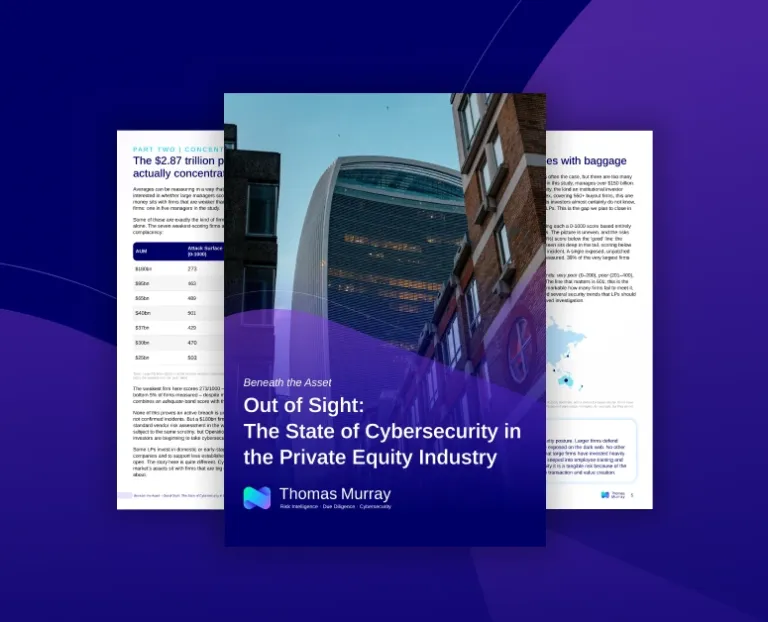
Beneath the Asset – Out of Sight: The State of Cybersecurity in the Private Equity Industry
The UK’s smallest investment funds are weak security link in protecting the IP needed for national growth, new Thomas Murray study finds.