

Information current as of 1 June 2026
This newsletter serves as a curated newsfeed of information relevant to the institutional community, as it navigates the proliferation of digital assets and distributed ledger technology. Thomas Murray has been on this journey since 2021, recognising a move into this space as a logical extension of its existing mission to support its global client base with capital market information, cybersecurity, provider and infrastructure ratings, and counterparty monitoring.
These newsletters are shaped using Thomas Murray's Digital Asset Market Information (DAMI), which provides asset owners, managers, intermediaries and VASPs with the regulatory clarity they need to operate confidently across digital asset markets. Currently covering 18 key jurisdictions and tracking over 100 markets in real time, Thomas Murray applies a consistent approach across ten dimensions, from regulation, asset classification and licensing to digital payment developments, taxation and custody frameworks – enabling fast, structured cross-jurisdictional comparison for strategic decision-making and risk management.
Delivered through Thomas Murray's Orbit Risk platform, DAMI combines deep-dive market knowledge with an intraday newsflash service, keeping clients ahead of the regulatory, infrastructure and policy developments shaping the digital assets ecosystem.
To find out more, or start a free trial, please contact Hugo Jack, Head of Digital.
Summary Extracts of Thomas Murray’s DAMI Newsflashes
DTCC Partners with Stellar for Public Blockchain Tokenisation
The Depository Trust & Clearing Corporation (DTCC) has announced plans to enable the tokenisation of DTC-eligible assets on the Stellar Development Foundation (SDF) public blockchain. This integration is designed to accelerate the tokenisation of traditional securities and streamline the associated lifecycle processes.
- Scope of Assets: DTCC and SDF will evaluate use cases for various asset classes, including U.S. Treasury bills, bonds, notes, and assets within the Russell 1000.
- Lifecycle Integration: The move aims to digitise not just the assets, but critical securities lifecycle functions such as reporting and corporate actions.
- Multi-Chain Strategy: This initiative is a key part of DTCC’s broader strategy to diversify its digital ecosystem and reduce dependency on any single technology vendor.
- Timeline: Tokenised assets are expected to be available on the Stellar network in H1 2027.
A link to the official press release by DTCC can be found here.
UK
Euroclear and Clearstream Propose Unified EU Framework for Debt Securities
To combat legal fragmentation across the EU, Euroclear and Clearstream are proposing a virtual ‘28th Regime.’ This unified framework would allow issuers to opt-in to a single set of rules for dematerialised debt, bypassing the varying requirements of individual Member States.
- Technology-Neutral: Supports both traditional book-entry and DLT (tokenised) assets.
- Streamlined: Simplifies issuance via electronic records without new licensing hurdles.
- Strategic Goal: A major catalyst for the adoption of digital assets within the EU Savings and Investment Union.
A link to Euroclear's official publication is available here: Proposed Framework on Dematerialised Debt Securities
PRA Publishes Dear CEO Letter on Tokenised Assets and Stablecoin Exposures
The Prudential Regulation Authority (PRA) has issued a "Dear CEO" letter updating its expectations on crypto-asset and stablecoin exposures. The PRA is adopting a nuanced approach, distinguishing between traditional assets on a blockchain and native crypto-assets.
- Same Risk, Same Outcome: Tokenised versions of traditional assets will generally be treated the same as their non-tokenised counterparts, provided the legal risks are comparable.
- Rigorous Governance: Crypto-related risks must be managed at the board level with specialised risk-management frameworks.
- Compliance: Full adherence to existing PRA requirements (Pillar 1, ICAAP, and Pillar 2) remains mandatory.
- Timeline: This guidance is interim; a final framework based on BCBS standards is expected by 2028.
A link to the PRA's publication is available here: PRA Letter
EU
EC Launches Targeted Consultation on Review of MiCA
The European Commission has opened a formal consultation to review the Markets in Crypto-Assets (MiCA) framework. The goal is to ensure the regulation evolves alongside the digital asset market and to address critical gaps in the original text.
- Closing the Gaps: Focus is on activities previously outside MiCA’s scope, specifically DeFi, staking, lending, borrowing, and NFTs.
- Stablecoin Oversight: Reviewing reserve requirements and redemption rights for Asset Referenced Tokens (ARTs) and E-money Tokens (EMTs).
- CASP and On-Chain Legalities: Assessing the adequacy of service provider frameworks and increasing legal certainty for natively issued on-chain assets.
- Next Steps: This consultation is a precursor to potential amendments that may bring DeFi and NFTs under formal regulation.
A link to the EC's official publication is available here: Consultation on Review of MiCA
Malta
MFSA Launches Consultation on Tokenisation
The Malta Financial Services Authority (MFSA) has launched a public consultation focused on the tokenisation of financial instruments and Real-World Assets (RWAs). The initiative is designed to create a comprehensive roadmap for Malta's emergence as a regulated hub for digital markets.
- Strategic Focus: Identifying priority asset classes and gauging industry appetite for tokenised markets.
- Infrastructure and Governance: Assessing the technical requirements and legal frameworks needed to ensure investor protection and robust risk management.
- Beyond Crypto: Shifting focus from general crypto-assets toward the digital representation of traditional financial instruments.
- Timeline: The MFSA is accepting industry feedback until June 30, 2026.
The MFSA is accepting feedback until 30 June 2026. The consultation document can be found here.
Malaysia
SC Malaysia Revises Guidelines on Recognised Markets for Digital Asset Exchanges
The Securities Commission (SC) Malaysia has updated its guidelines for recognised markets to professionalise the Digital Asset Exchange (DAX) landscape. The new rules aim to balance faster market entry with more rigorous operational standards.
- Agility vs. Accountability: While the SC is streamlining approval processes to accelerate product launches, it has raised the bar for management proficiency and financial stability for DAX operators.
- Enhanced Protection: New requirements strengthen client asset protection and overall governance to improve operational resilience.
- Zero Tolerance: Alongside these updates, the SC is aggressively targeting unregulated entities, recently penalising four unregistered exchanges.
- Strategic Shift: The move signals a transition toward a high-barrier, professionalised ecosystem that rewards compliance and purges unregulated operators.
Links to the official announcement and guideline amendments are available here: SC Malaysia Press Release.

Other External News Items
Legal and Regulation
B2C2 Secures First MiCA CASP Licence for a Global OTC Liquidity Provider
B2C2 has become the first global OTC crypto liquidity provider to obtain a MiCA Crypto-Asset Service Provider licence, granted by Luxembourg's CSSF on 13 May 2026.
Key details:
- The firm can now passport its 24/7 spot crypto trading services with near-instant settlement across all EU and EEA member states
- The licence was secured ahead of the July 2026 MiCA transition deadline
- B2C2 previously held VASP registration in Luxembourg since 2024, with the upgrade to full CASP status reflecting growing regulatory maturity in the sector
The authorisation sets a benchmark for other OTC and liquidity-focused firms navigating the MiCA licensing process.
Federal Reserve Proposes New "Payment Account" for Non-Bank Financial Institutions
The Federal Reserve has opened a public consultation on a proposal to create a dedicated "payment account" giving eligible financial institutions – including stablecoin issuers and digital asset firms – direct access to the Fed's payment infrastructure.
Key details:
- Account holders would face strict limitations, with no access to intraday credit, the discount window, or interest on balances
- Reserve Banks have been asked to pause Tier 3 access decisions, the category most relevant to non-traditional financial institutions, until the policy process is complete
- The proposal builds on a December 2025 prototype, with modest updates including higher permissible closing balance limits
For digital asset firms, the proposal offers a meaningful, if tightly controlled, pathway to central bank settlement infrastructure, reducing dependence on correspondent banking.
FDIC Proposes BSA and Sanctions Compliance Framework for Stablecoin Issuers
The FDIC has approved a proposed rule imposing Bank Secrecy Act and sanctions compliance obligations on FDIC-supervised stablecoin issuers under the recently enacted GENIUS Act, open for public comment for 60 days.
Key details:
- Covered issuers: stablecoin-issuing subsidiaries of insured state non-member banks and state savings associations must maintain AML/CFT programmes aligned with FinCEN requirements and adhere to OFAC sanctions obligations
- The FDIC is deferring to Treasury on AML/CFT standards rather than creating a parallel regime, reflecting a deliberate effort to avoid regulatory fragmentation
- Supervision and enforcement provisions are brought into line with existing FinCEN standards
For stablecoin issuers within the FDIC's supervisory perimeter, the proposal provides early compliance clarity under the GENIUS Act, signalling that financial crime risk management will be a central pillar of the US federal stablecoin framework from the outset.
Partnerships / Ecosystem
LMAX Group Launches Kiosk to Enable Digital Assets as Cross-Asset Collateral
LMAX Group has launched Kiosk, a hosted institutional portal enabling clients to deposit digital assets into LMAX Custody and deploy them as collateral across a multi-asset product suite covering spot FX, precious metals, digital assets, CFDs and perpetual futures.
Key details:
- The platform consolidates deposit and withdrawal workflows, API management, WalletConnect connectivity and treasury tools into a single interface
- Kiosk is designed to eliminate the operational fragmentation that has historically complicated digital asset integration for institutions
- Clients can activate digital asset holdings as collateral without manual reconciliation across disparate systems
For market participants, the launch represents the collateral transformation use case moving from concept to live infrastructure, with a regulated liquidity venue providing the connectivity layer between custody and trading.
Boerse Stuttgart's Seturion Secures SocGen, SG-FORGE and flatexDEGIRO in Pan-European Tokenised Settlement Push
Boerse Stuttgart's tokenised securities settlement platform, Seturion, has partnered with Societe Generale, its crypto subsidiary SG-FORGE, and retail broker flatexDEGIRO, marking a significant step towards pan-European blockchain-based settlement infrastructure.
Key details:
- Societe Generale will issue tokenised structured securities settled in SG-FORGE's MiCA-compliant CoinVertible euro and US dollar stablecoins
- flatexDEGIRO will connect retail investor flow across 16 European markets to the platform, providing immediate distribution scale
- Seturion supports both public and private blockchains and can settle against on-chain and central bank money, with Nasdaq's European venues also set to connect
For market participants, the collaboration represents one of the most substantive live deployments of tokenised securities infrastructure in Europe to date.
Bank of England Signals Retreat on Stablecoin Ownership Limits and Reserve Requirements
The Bank of England is reconsidering key elements of its proposed stablecoin framework following industry opposition, with Deputy Governor Sarah Breeden signalling the central bank is "genuinely open" to alternative approaches.
Key details:
- Individual ownership caps of £20,000 and a £10 million business limit have drawn criticism as operationally cumbersome
- A requirement for systemic issuers to hold 40% of backing assets at the Bank of England on a non-interest-bearing basis has faced significant pushback, with Breeden conceding the Bank may have been "overly conservative"
- Industry bodies including the Payments Association and Innovate Finance warned the proposals risked stifling innovation and disadvantaging UK issuers relative to MiCA-regulated EU peers
The softening in tone is notable given the Bank's historically cautious stance, and will be closely watched by payments firms and digital asset issuers looking to establish or scale under the UK's forthcoming stablecoin regime.
Qivalis Euro Stablecoin Consortium Expands to 37 Banks Ahead of H2 2026 Launch
Qivalis, the Amsterdam-based joint venture established by European banks to issue a shared euro stablecoin, has added 25 new member institutions, bringing total consortium membership to 37 banks. New entrants include ABN AMRO, Intesa Sanpaolo, Nordea, Rabobank and Bank of Ireland, joining founding members such as BBVA, BNP Paribas, UniCredit and ING.
Key details:
- Qivalis is awaiting EMI authorisation from De Nederlandsche Bank, with a commercial launch targeted for H2 2026
- The stablecoin is positioned for cross-border payments and atomic settlement of tokenised assets – not as a substitute for existing domestic European payment infrastructure
- Discussions are underway with non-European banks active in remittance corridors into Europe
With 37 banks representing a significant share of European banking capacity, Qivalis is emerging as the most broadly supported bank-led stablecoin initiative on the continent, and a potential counterweight to both US dollar-denominated stablecoins and the ECB's digital euro project.

Digital Asset Custodian Monitoring
Our DACM solution sets a standard for transparency and risk intelligence in digital markets. Against an industry that is complex, fragmented, unstandardised, and fraught with cyber risk, our solution provides you with the tools and insights to effectively evaluate, select and monitor your digital asset custodian.
Insights

How Often Should ODD Be Refreshed? A Practical Framework
Most allocators do a full ODD review every 12 to 36 months, but the right cadence depends on risk. Here's a practical five-step framework for deciding how often to review each manager.

Private Equity Has a Cyber Risk Blind Spot
Private equity has become much better at assessing cyber risk, but it may be looking in the wrong place.

What AI Actually Changes About the DDQ (and What It Doesn't)
AI is transforming DDQ workflows, but it doesn't change what a questionnaire actually is: self-reported data. Here's where the line falls, and what to ask before adopting an AI-assisted tool.
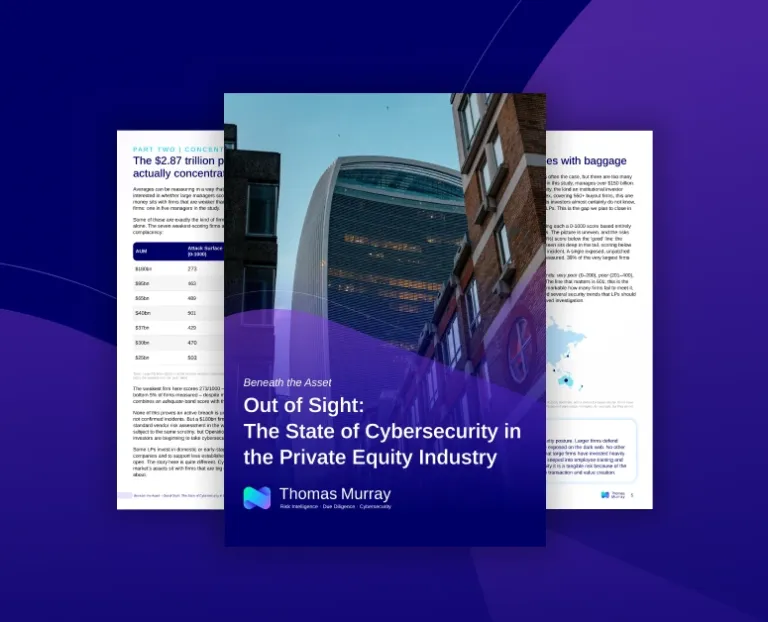
Beneath the Asset – Out of Sight: The State of Cybersecurity in the Private Equity Industry
The UK’s smallest investment funds are weak security link in protecting the IP needed for national growth, new Thomas Murray study finds.