

Information current as of 9 July 2026
This newsletter serves as a curated newsfeed of information relevant to the institutional community, as it navigates the proliferation of digital assets and distributed ledger technology.
These newsletters are shaped using Thomas Murray's Digital Asset Market Information (DAMI), which provides asset owners, managers, intermediaries and VASPs with the regulatory clarity they need to operate confidently across digital asset markets. Currently covering 18 key jurisdictions and tracking over 100 markets in real time, Thomas Murray applies a consistent approach across ten dimensions, from regulation, asset classification and licensing to digital payment developments, taxation and custody frameworks – enabling fast, structured cross-jurisdictional comparison for strategic decision-making and risk management.
Delivered through Thomas Murray's Orbit Risk platform, DAMI combines deep-dive market knowledge with an intraday newsflash service, keeping clients ahead of the regulatory, infrastructure and policy developments shaping the digital assets ecosystem.
To find out more, or start a free trial, please contact Hugo Jack, Head of Digital Assets.
Summary Extracts of Thomas Murray’s DAMI Newsflashes
UK
Financial Conduct Authority Publishes Final Cryptoasset Regime Policy Statements
The Financial Conduct Authority (FCA) has published five policy statements (PS26/9 through PS26/13) setting out the final rules for its comprehensive cryptoasset regime, underpinned by the Financial Services and Markets Act 2000 (Cryptoassets) Regulations 2026. The regime covers trading platforms, custody, staking, lending and borrowing, stablecoin issuance, and admissions and disclosures. Key changes from consultation include: the stablecoin capital requirement coefficient reduced from 2% to 1%; Client Assets Sourcebook (CASS) 17 applied to cryptoasset safeguarding; and a simplified market risk framework applying a single 40% net risk position requirement to qualifying cryptoassets. Existing registrations do not convert automatically. Firms must apply for full Financial Services and Markets Act (FSMA) authorisation. The savings provisions application window opens 30 September 2026 and closes 28 February 2027, with the full regime commencing 25 October 2027.
A link to the FCA's official publication is available here: Overview of Cryptoasset Regime Policy Statements
USA
United States Financial Crimes Enforcement Network Issues Proposed Rule on Customer Identification for Stablecoin Issuers
The United States Department of the Treasury's Financial Crimes Enforcement Network (FinCEN), together with the Office of the Comptroller of the Currency, the Federal Reserve, the Federal Deposit Insurance Corporation, and the National Credit Union Administration, has issued a proposed rule requiring Permitted Payment Stablecoin Issuers to establish Customer Identification Programmes under the GENIUS Act. Issuers must collect name, date of birth, address, and identification number from all customers prior to opening an account; verify identity using documentary and non-documentary methods; screen against government watchlists; and maintain full records. Exemptions exist for certain institutional customers, and reliance on another federally regulated financial institution to perform verification is permitted where reasonable. Comments are invited via regulations.gov under Docket FINCEN-2026-0101.
Further information on the proposed rule is available here.
Paraguay
Paraguay Enacts New Securities and Products Market Law with Tokenisation Provisions
Paraguay has enacted Law No. 7572/25 on the Securities and Products Market (Mercado de Valores y Productos), a comprehensive reform of the country's capital markets legal framework. The law contains provisions expressly addressing tokenisation, integrating distributed ledger technology-based instruments into the regulated securities framework and providing a legal basis for the public offering of tokenised assets. The Central Bank of Paraguay is empowered to authorise foreign issuers registered on regulated markets abroad to operate within the Paraguayan market. The law cross-references existing electronic trust and document legislation, signaling a coherent effort to embed digital assets within the broader legal infrastructure rather than treat them as a separate category.
A link to the official press release by CAVAPY (in Spanish) can be found here.
Luxembourg and Germany
Clearstream's D7 Distributed Ledger Technology-Issued Securities Now Accepted as Eurosystem Collateral
Securities issued via Clearstream's tokenised issuance platform, D7 Distributed Ledger Technology (DLT), are now eligible as collateral in the Eurosystem Collateral Management System (ECMS), the European Central Bank's centralised infrastructure for managing collateral in Eurosystem credit operations. The development is significant: it means that digitally native securities, issued directly on a distributed ledger, can now be mobilised as collateral for central bank liquidity operations, placing them on equal footing with conventional securities for this purpose. Clearstream is currently the only triparty agent connected to ECMS, giving it a structural advantage in routing DLT-native assets into Eurosystem operations.
A link to the official announcement is available here: Securities Issued in Clearstream’s D7 DLT Now Accepted as Eurosystem Collateral.
South Africa
South African Revenue Service Publishes Draft Guide to the Taxation of Crypto Assets
The South African Revenue Service (SARS) has published a draft guide setting out its approach to the income tax and capital gains tax treatment of crypto assets. The guide covers the tax consequences of acquiring, holding, trading, mining, staking, and disposing of crypto assets, and addresses both individual and corporate taxpayers. SARS takes the position that crypto assets are not currency for tax purposes, meaning gains are treated as either revenue (trading) or capital (investment) depending on the taxpayer's intent and conduct. The guide also addresses less straightforward scenarios including hard forks, airdrops, and decentralised finance activity.
You can access the draft guide here.

Other External News Items
Thought Leadership
IMF: Tokenisation Can Change the World's Financial Architecture
The International Monetary Fund (IMF) has published a wide-ranging analysis arguing that tokenisation is not just a technological upgrade, it is a structural change to how financial systems work. When assets move onto shared ledgers, sequential processes (execution, clearing, settlement) collapse into simultaneous ones, and risk migrates from institutional balance sheets towards the platforms and code that govern transactions. The IMF identifies three emerging forms of digital settlement money: tokenised bank deposits, stablecoins, and tokenised central bank reserve, each with distinct risk profiles. It warns that frictionless settlement removes the buffers that currently give markets time to absorb stress, and flags particular risks for emerging economies from rapid cross-border capital flows and currency substitution. Policy choices made now will determine whether tokenisation strengthens or fragments the global financial system.
Regulatory Developments
Standard Chartered Granted MiCA CASP and Electronic Money Institution Licence in Europe
Standard Chartered has received both a Markets in Crypto-Assets Regulation (MiCA) Crypto Asset Service Provider (CASP) authorisation and an Electronic Money Institution (EMI) licence in Europe, giving the bank a comprehensive regulatory foundation to offer digital asset and digital payment services across the European Economic Area (EEA). The dual licence positions Standard Chartered as one of a small number of global banks to hold full MiCA authorisation, enabling it to serve institutional clients in the European Union under a single, passportable regulatory framework.
Ripple Receives Full MiCA Crypto Asset Service Provider Authorisation in Luxembourg
Ripple has received full Crypto Asset Service Provider (CASP) authorisation from Luxembourg's Commission de Surveillance du Secteur Financier (CSSF), completing its Markets in Crypto-Assets Regulation (MiCA) compliance and making its regulated crypto payments product available to financial institutions across all 30 European Economic Area (EEA) countries. The authorisation adds to Ripple's existing European Union Electronic Money Institution (EMI) licence and its global portfolio of over 75 regulatory licences, and follows a preliminary approval announced in June 2026.
FalconX Receives MiCA Authorisation from Malta's Financial Services Authority
FalconX, a leading institutional digital asset prime broker serving over 2,000 institutional clients globally, has received Markets in Crypto-Assets Regulation (MiCA) authorisation from the Malta Financial Services Authority (MFSA). The licence covers trading, custody, and liquidity solutions for institutional clients across the European Union and European Economic Area, and complements FalconX's recently announced acquisition of 21shares. The firm has facilitated over $2.5 trillion in trading volume since inception and operates the first Commodity Futures Trading Commission (CFTC)-registered swap dealer focused on digital asset derivatives.
Sygnum Europe Scales EU Market Access Under MiCA Regulation Licence
Sygnum Europe has obtained a Crypto Asset Service Provider (CASP) licence under the Markets in Crypto-Assets Regulation (MiCAR) from Liechtenstein's Financial Market Authority (FMA), positioning the digital asset banking group to scale its European Union client base as the MiCAR transition period ends. The licence is backed by Sygnum's existing global banking platform across Switzerland, Singapore, and the Middle East, and targets high-net-worth individuals, institutional investors, and banks. A notable feature is its Bank-to-Bank infrastructure, designed to help European banks launch digital asset services without building their own technology stack, relevant given that most of Europe's 5,000+ banks have yet to offer digital assets to clients.
Bitcoin Suisse Receives Financial Services Permission from Abu Dhabi Global Market's Financial Services Regulatory Authority
Bitcoin Suisse's United Arab Emirates (UAE) subsidiary, BTCS (Middle East) Ltd., has received Financial Services Permission (FSP) from the Financial Services Regulatory Authority (FSRA) of Abu Dhabi Global Market (ADGM), following a multi-stage licensing process. The authorisation enables the firm to offer regulated digital asset financial services including institutional-grade custody, trading of approved virtual assets, and digital asset exposure management, to institutional and professional clients in the UAE. Bitcoin Suisse currently safeguards $3.7 billion in crypto assets and is the fourth-largest staking operator globally.
Products / Pilots
Ondo Finance Launches First Custodial Tokenised Securities Inside the US Regulatory Perimeter
Ondo Finance has become the first firm to tokenise United States-listed securities, BlackRock's iShares S&P 500 Exchange-Traded Fund (ETF) (IVV) and Micron (MU) shares, as a third party entirely within the existing US regulatory framework. Under the Securities and Exchange Commission's (SEC) custodial model, the underlying shares never leave the traditional custody chain; Ondo's registered transfer agent mints corresponding tokens on Ethereum, backed 1:1 by those shares. Broadridge will provide proxy voting and shareholder communications for token holders via its ProxyVote.com platform, ensuring they receive the same rights and protections as conventional shareholders. Until now, tokenised securities in the United States have either been issuer-sponsored or operated outside the regulatory perimeter altogether.
Major Payment Networks Back New Stablecoin Consortium
A group of major payment institutions including Mastercard, PayPal, Visa, Robinhood, Nuvei, and Galoy, have backed a new stablecoin initiative aimed at building interoperable dollar-denominated payment infrastructure. The consortium model reflects a broader industry view that the stablecoin market should not be controlled by a single issuer, and that open, payment-network-backed alternatives are needed to prevent fragmentation. Details on the specific stablecoin structure and governance have not yet been fully disclosed.
Standard Chartered and LMAX Group Execute First Live Digital Asset Prime Brokerage Trades
Standard Chartered and LMAX Group have executed their first live trades under a digital asset prime brokerage arrangement, marking the launch of a bank-backed prime brokerage service for institutional crypto markets. The partnership combines Standard Chartered's balance sheet and credit intermediation with LMAX's institutional-grade execution venue, providing clients with the same credit and operational efficiencies in digital assets that prime brokerage delivers in traditional markets.
Anchorage Digital Adds Lido Support, Expanding Institutional Access to Ethereum Liquid Staking
Anchorage Digital, the only federally chartered digital asset bank in the United States, has integrated support for Lido, the largest Ethereum liquid staking protocol, enabling institutional clients to stake Ether (ETH) and receive stETH (liquid staking tokens) directly from custody. This addition means institutions no longer need to move assets off-platform to access liquid staking yields, reducing counterparty risk and operational complexity. It reflects growing institutional demand for yield-generating strategies on custodied digital assets.
Clearstream Expands Crypto Custody Offering with Six New Assets
Clearstream has expanded its MiCA (Markets in Crypto-Assets Regulation) regulated crypto custody service, launched last year using Crypto Finance (part of Deutsche Börse Group) as sub-custodian, to cover six additional cryptocurrencies: Ripple (XRP), Cardano (ADA), Solana (SOL), Litecoin (LTC), Stellar (XLM), and Avalanche (AVAX), in addition to the existing Bitcoin (BTC) and Ether (ETH) offering. The expansion broadens the range of MiCA-compliant assets available to institutional clients within established custody infrastructure, continuing Clearstream's strategy of bridging traditional post-trade services with the crypto asset market.

Digital Asset Custodian Monitoring
Our DACM solution sets a standard for transparency and risk intelligence in digital markets. Against an industry that is complex, fragmented, unstandardised, and fraught with cyber risk, our solution provides you with the tools and insights to effectively evaluate, select and monitor your digital asset custodian.
Insights

How Often Should ODD Be Refreshed? A Practical Framework
Most allocators do a full ODD review every 12 to 36 months, but the right cadence depends on risk. Here's a practical five-step framework for deciding how often to review each manager.

Private Equity Has a Cyber Risk Blind Spot
Private equity has become much better at assessing cyber risk, but it may be looking in the wrong place.

What AI Actually Changes About the DDQ (and What It Doesn't)
AI is transforming DDQ workflows, but it doesn't change what a questionnaire actually is: self-reported data. Here's where the line falls, and what to ask before adopting an AI-assisted tool.
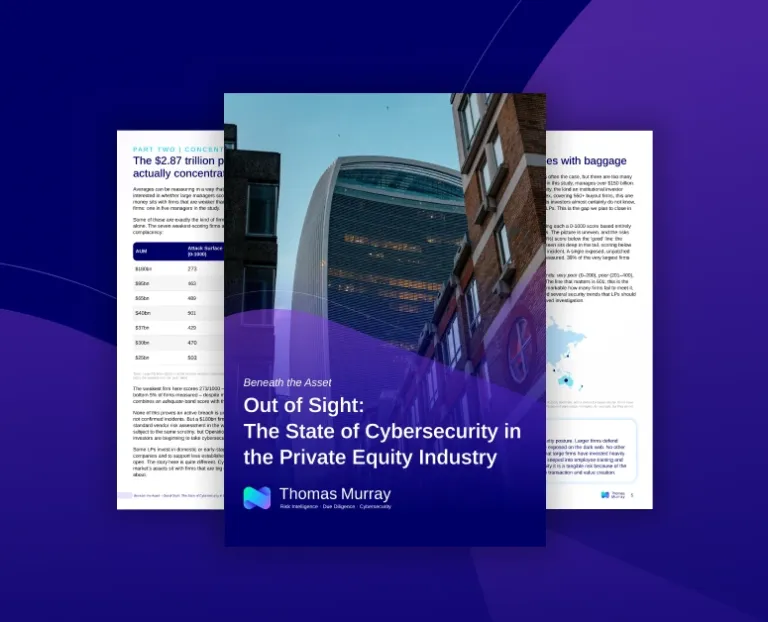
Beneath the Asset – Out of Sight: The State of Cybersecurity in the Private Equity Industry
The UK’s smallest investment funds are weak security link in protecting the IP needed for national growth, new Thomas Murray study finds.