

This newsletter serves as a curated newsfeed of information relevant to the institutional community, as it navigates the proliferation of digital assets and distributed ledger technology. It is shaped using Thomas Murray's Digital Asset Market Information (DAMI), which provides asset owners, managers, intermediaries and VASPs with the regulatory clarity they need to operate confidently across digital asset markets. Currently covering 18 key jurisdictions and tracking over 100 markets in real time, Thomas Murray applies a consistent approach across ten dimensions, from regulation, asset classification and licensing to digital payment developments, taxation and custody frameworks, enabling fast, structured cross-jurisdictional comparison for strategic decision-making and risk management.
Information current as of 23 July 2026
Global
Swift Launches Blockchain-Based Ledger for Tokenised Cross-Border Payments
Swift has announced that its blockchain-based ledger is ready for initial use, enabling early adopter financial institutions to support 24/7 cross-border payments with tokenised deposits. The ledger provides a secure orchestration layer for bank-issued tokenised deposits, facilitating the movement of funds, including during non-business hours and weekends, before final settlement is completed through existing systems. This development follows a nine-month build period based on feedback from international financial institutions.
Seventeen banks across six continents are preparing to pilot live transactions on the ledger, including: ANZ, BNP Paribas, BNY, Citi, DBS, First Abu Dhabi Bank (FAB), FirstRand Bank Limited, HSBC, Itaú Unibanco, Lloyds Bank, Mashreq, MUFG Bank, OCBC, Standard Chartered, UBS, UOB, and Wells Fargo. The initiative is designed to unlock faster and more flexible money movement for banks without compromising the high standards of compliance, credit, risk, and control embedded in current payment processing.
Read more: Swift’s Blockchain Ledger.
USA
DTCC Advances Development of DTC Tokenisation Service - Update
The Depository Trust & Clearing Corporation (DTCC) has taken its tokenisation plans a step further. On 15 July, it converted assets held at the Depository Trust Company (DTC) into tokens for genuine production trades, real transactions with more than 30 participants from both traditional and digital markets taking part. The exercise ran across two networks (DTCC's own private Besu-based ledger and the public Canton network) and covered a broad spread of use cases: collateral pledges, securities lending, Treasury/repo delivery-versus-payment (DvP), equity DvP and delivery-versus-delivery (DvD), and central counterparty (CCP) margin workflows. It's a deliberate stress-test of whether tokenised infrastructure can match the resilience of the systems it might one day sit alongside. Full launch is pencilled in for October 2026, building on the U.S. Securities and Exchange Commission's (SEC) No-Action Letter from last December.
Further information is available here: DTCC Press Release and DTCC Live Production Trades.
Switzerland
SIX x-clear Expands Clearing Offering for Crypto Exchange Traded Products (ETP)
SIX x-clear has broadened what it will clear for crypto ETPs, adding Binance Coin, Solana and Ripple to the existing Bitcoin and Ethereum lineup. Eligibility covers unleveraged and modestly leveraged (up to 2x) long/short tracker products, plus basket ETPs that meet the usual risk criteria. Given how these underlyings can swing, x-clear is keeping its special margining provisions firmly in place. The expanded list went live on 1 July 2026.
A link to SIX x-clear's official publication is available here: SIX x-Clear Expands Clearing Offering for Crypto ETPs
Brazil
BCB Establishes Prudential Framework for Companies Providing Virtual Asset Services
Brazil's Central Bank (BCB) has formally brought virtual asset service providers into its regulatory fold. Under Resolution 580/2026, Virtual Asset Providers (VASPs) and any prudential conglomerates they lead are now classed as Type 3 institutions, putting them squarely under BCB oversight and simplified-regime firms (Segment 5) are now barred from offering VASP services altogether. From January 2027, that means real prudential obligations: risk management, capital requirements, disclosure, the works. It is the latest concrete step in rolling out the framework Brazil set up back in 2022–23.
A link to the official press release by the BCB (in Portuguese) can be found here.
Kazakhstan
KASE Issues Internal Rules on Digital Asset Platform Operator Activities
The Kazakhstan Stock Exchange (KASE) has published its internal rulebook for running digital asset and digital financial asset platforms, in force since 15 July. KASE positions itself as operator of both the trading platform and the custody arrangements for underlying assets, with clients needing to meet licensing and Financial Action Task Force (FATF)-linked eligibility requirements to participate. Notably, trading is digital asset (DA) for digital financial asset (DFA) swaps only, no cash legs, settlement happens immediately within KASE's own accounting system once assets are pre-deposited, and DFA issuance gets registered on a public blockchain before being reported to the Central Depository. A tightly controlled, self-contained model.
The official KASE announcement and a copy of the Rules can be accessed here (in Russian): KASE Notice.
UK
His Majesty's Treasury Launches Consultation on Recognised Payment Systems and DSA Service Providers Fee Regime
HM Treasury has opened a consultation on how it plans to charge recognised payment systems and digital settlement asset service providers for supervision. The headline proposals: bring digital settlement asset (DSA) providers into the Bank of England's existing fee regime (though nothing bites until a provider is actually recognised), lift the annual supervisory fee cap to £1.7 million per in-scope entity, and raise the Special Project Fee cap to £650,000 to keep pace with inflation. Responses are due by 31 August 2026.
A link to the consultation is available here: Recognised Payment Systems and Digital Settlement Asset Service Providers Fee Regime Consultation.

Other External News
Circle Receives Final National Trust Bank Approval
Circle has cleared the last hurdle to operate as a national trust bank in the US, a milestone that hands the stablecoin issuer a federal charter and puts it on a more regulated footing alongside traditional banking players. Rather than lobbying for bespoke crypto rules, Circle worked within the Office of the Comptroller of the Currency’s (OCC) existing national trust bank framework, filing its application in June 2025 and moving through conditional approval to final sign-off over the course of a year. It kept its initial ask narrow, limiting the charter to custody services for its own affiliates while building in room to expand to institutional clients and reserve management down the line. It's a significant vote of confidence from US regulators and one that could shape how other stablecoin issuers approach their own charter ambitions.
Read more here.
Zodia Solutions and TCS Partner to Offer Digital Asset Execution and Custody to Banks
Zodia Solutions and Tata Consultancy Services (TCS) have announced a strategic integration, embedding digital asset execution and custody capabilities within the SWIFT-certified TCS BaNCS™ Global Securities Platform. This synergy allows banks to offer crypto and tokenised asset services via existing accounts and settlement rails, bridging traditional conventions with blockchain finality. By deploying Zodia’s wallet and orchestration infrastructure within their own environments, banks retain full governance and private key ownership. This integration allows digital assets to be managed within the same operational framework as conventional classes, with TCS BaNCS overseeing the entire lifecycle from order instruction to on-chain reconciliation.
Read more here.
Visa Introduces a Platform for Stablecoin Minting, Movement and Management
Visa has launched the Visa Stablecoin Platform (VSP), giving financial institutions, fintechs and crypto-native firms a single, Visa-managed environment to mint, hold, redeem and move stablecoins, starting with Open USD, the newly launched stablecoin from Open Standard. The platform bundles in wallet infrastructure (via a new Wallet-as-a-Service offering), dual-control approvals, audit logging and allow-lists, and plugs directly into Visa's existing settlement, treasury and network tools so clients can fold stablecoin activity into workflows they already run. It's currently in beta with select clients. Read as a signal that the card networks aren't waiting on the sidelines for institutional stablecoin infrastructure, they're building it themselves.
Read more: Visa Investor Relations
Citadel Securities Invests $400M Into Crypto.com
Crypto.com has landed a $400 million investment from market maker Citadel Securities, valuing the exchange at $20 billion, its first institutional funding round since launching in 2016. The capital is earmarked for expansion across asset classes, including tokenised securities and derivatives, as Crypto.com looks to bridge digital asset and traditional markets into a single 24/7 ecosystem. The deal lands shortly after Crypto.com picked-up conditional approval from US regulators for a national trust bank charter, adding to a run of institutional players formalising their US regulatory footing.
Read more: Finextra

Digital Asset Custodian Monitoring
Our DACM solution sets a standard for transparency and risk intelligence in digital markets. Against an industry that is complex, fragmented, unstandardised, and fraught with cyber risk, our solution provides you with the tools and insights to effectively evaluate, select and monitor your digital asset custodian.
Insights

How Often Should ODD Be Refreshed? A Practical Framework
Most allocators do a full ODD review every 12 to 36 months, but the right cadence depends on risk. Here's a practical five-step framework for deciding how often to review each manager.

Private Equity Has a Cyber Risk Blind Spot
Private equity has become much better at assessing cyber risk, but it may be looking in the wrong place.

What AI Actually Changes About the DDQ (and What It Doesn't)
AI is transforming DDQ workflows, but it doesn't change what a questionnaire actually is: self-reported data. Here's where the line falls, and what to ask before adopting an AI-assisted tool.
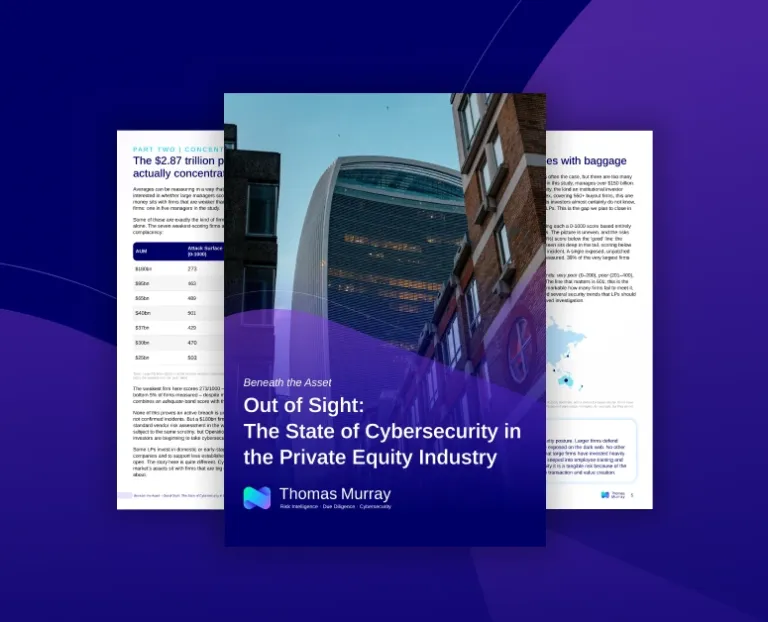
Beneath the Asset – Out of Sight: The State of Cybersecurity in the Private Equity Industry
The UK’s smallest investment funds are weak security link in protecting the IP needed for national growth, new Thomas Murray study finds.