

Information current as of 16 December 2025
UK’s New Digital Assets Law Formally Recognises Crypto as Personal Property
Millions of crypto owners have gained stronger legal protection as the UK’s Property (Digital Assets etc.) Act received Royal Assent in December.
This confirms in law that digital assets, such as cryptocurrency or non-fungible tokens, can now be recognised as personal property. This will provide greater protections and ensure they are treated like traditional assets.
OCC Confirms Banks Can Execute Riskless Principal Crypto Transactions
The Office of the Comptroller of the Currency (OCC) has confirmed that national banks can execute riskless principal crypto trades, allowing financial institutions to facilitate digital asset transactions without assuming inventory risk.
Interpretive Letter 1188 confirms that such transactions involve a bank acting as principal in a crypto-asset transaction with one customer while simultaneously entering into an offsetting transaction with another customer. The bank serves as an intermediary and does not hold the crypto assets in inventory, instead acting in a capacity equivalent to that of a broker acting as agent.
CFTC Launches Digital Assets Pilot Allowing Bitcoin, Ether and USDC as Collateral
The Commodity Futures Trading Commission (CFTC) has launched a pilot programme, allowing bitcoin, ether and USD Coin to be used as collateral in US derivatives markets. The programme is part of a broader push to give market participants clear rules for using tokenised collateral, including tokenised versions of real-world assets like US Treasuries.
The program is aimed at approved futures commission merchants and includes strict custody, reporting and oversight requirements.
The agency also issued updated guidance for tokenised assets and withdrew outdated restrictions following the GENIUS Act.
FCA Announces Regulatory Stablecoin Sandbox
The Financial Conduct Authority (FCA) has opened applications to its regulatory sandbox for prospective UK stablecoin issuers. The stablecoin sandbox will allow issuers to test their stablecoin solutions in a controlled environment and help to shape future policy.
Who should apply
- Firms planning to issue a stablecoin in the UK under the upcoming regime.
- Companies ready to test their stablecoin and help shape policy.
Stakeholders can submit their applications until 18 January 2026.
Securitize Gains EU Regulatory Approval for TSS
Securitize, a platform specialising in the tokenisation of real-world assets, announced in November that it has obtained regulatory approval to operate in the EU, both as an Investment Firm and as a Trading and Settlement System (TSS). The TSS allows Securitize to integrate the functions of a Multilateral Trading Facility (MTF) and a Central Securities Depository (CSD) within a single digital framework.
In line with this, Securitize will launch its European TSS on the Avalanche blockchain, utilising the network’s high‑performance architecture for regulated markets. The company now holds the only worldwide licences that permit it to run regulated digital‑securities infrastructure in both the US and the EU, allowing issuers and investors to operate across the two largest capital markets.
Securitize’s first issuance on Avalanche under the EU TSS is expected early 2026.
State Street, Galaxy to Launch Tokenised Liquidity Fund
State Street and Galaxy Asset Management plan to launch a tokenised liquidity fund in early 2026. This fund will use stablecoins for around-the-clock investor flows, expanding the use of public blockchains in institutional cash management.
The State Street Galaxy Onchain Liquidity Sweep Fund is a private fund available to qualified purchasers. State Street Bank will serve as custodian for the fund’s assets, while Galaxy’s digital infrastructure will handle tokenisation and issuance.
The fund will launch on Solana’s blockchain, with subsequent integrations planned for Stellar and Ethereum, using Chainlink for cross-chain functionality.
Kraken and Deutsche Börse Group Announce Partnership to Bridge Traditional and Digital Markets
Cryptocurrency platform, Kraken, and financial market infrastructure, Deutsche Börse Group, have announced a strategic partnership to create unified access across traditional and digital asset markets.
Effective 4 Dec 2025, the two firms will leverage their complementary capabilities to bridge traditional financial markets and the digital asset economy. Spanning trading, custody, settlement, collateral management, and tokenised assets, the partnership will unlock a new range of enhanced products and services that deliver frictionless access to both ecosystems, creating a holistic experience for institutional clients.
EU Commission Floats Major DLT Pilot Regime Upgrade (ESMA to Direct MiCA CASPs)
The European Commission has proposed a major upgrade to the DLT Pilot Regime (DLTPR), the framework that governs the trading and settlement of tokenised financial instruments, including stocks and bonds.
The pilot upgrade focuses on removing regulatory barriers to innovation related to distributed ledger technology, adapting the regulatory framework to support these technologies and amends the DLTPR to relax limits, increase proportionality and flexibility, and provide legal certainty, thus encouraging the adoption of new technologies in the financial sector.
The broader package of proposals includes targeted amendments to MiCA crypto regulations, particularly the widely floated proposal for ESMA to authorise, monitor and supervise all crypto asset services providers (CASPs), rather than national regulators.
Abu Dhabi Launches Digital Assets-Focused Fintech Centre
Abu Dhabi has launched the Fintech, Insurance, Digital and Alternative Assets cluster, with the claim that it will add AED56bn to their GDP by 2045.
The cluster is designed to consolidate the emirate's fintech landscape and is described as a "strategic step towards building an integrated global financial ecosystem that harnesses capital, innovation, advanced technologies and AI solutions."
Abu Dhabi currently has more than $1.8trn in sovereign wealth. As part of the UAE, it also has a growing fintech market. In July this year, the UAE overtook the UK as the second biggest fintech market globally with $2.2bn in investment in the first half of 2025.
Taurus and Everstake Announce Partnership to Advance Institutional Staking Globally
Taurus, a global leader in digital asset infrastructure, and Everstake, one of the largest global non-custodial staking providers for institutional and retail clients, have announced a strategic partnership to integrate Everstake’s enterprise-grade staking infrastructure into the Taurus digital asset platform.
The collaboration will enable Taurus’ global banking and institutional clients to access Everstake’s secure and compliant staking services while maintaining full control and ownership of their assets through the Taurus-PROTECT platform, the custody solution built for banks and regulated institutions.
Victor Busson, Chief Marketing Officer at Taurus, said: “Our partnership with Everstake expands the range of staking options available to our institutional clients while maintaining Taurus’ standards for security, governance, and regulatory compliance.”
National Policy on Virtual Assets and Virtual Assets Service Providers
The Virtual Asset Service Providers Act (VASP Act), introduces Kenya's first dedicated framework for virtual assets, and brings in licensing and compliance requirements for virtual asset service providers, including strong anti-money laundering and counter-terrorism financing controls, minimum capital and solvency thresholds, improved cybersecurity measures, and better governance. The Act aims to safeguard market integrity and consumer protection.
South Korea's NH NongHyup Bank Pilots Blockchain-Based Cross-Border Payments with Partior
South Korea’s NH NongHyup Bank has successfully completed a pilotof blockchain-based cross-border payments, conducted via Partior’s blockchain platform. JP Morgan, an investor in Partior, acted as both the beneficiary and settlement bank in the pilot.
Used by the world’s leading banks, Partior’s blockchain solutions are built to integrate with core banking systems, offering 24/7, always-on capabilities, to ensure efficient real-time settlement with finality.
The pilot marks the first instance in South Korea where a financial institution has tested a blockchain payment network that’s already in commercial use by leading global banks (including JP Morgan, DBS, Standard Chartered, and Deutsche Bank). The results confirmed that blockchain-based payments can be implemented reliably within South Korea’s current regulatory environment.
US Bank Tests Stablecoin Issuance on Stellar Network
US Bank, in tandem with PwC and the Stellar Development Foundation (SDF), has begun testing the issuance of custom stablecoins on the Stellar network. The bank is exploring whether a traditional bank can safely issue programmable money on a public blockchain.
Mike Villano, Senior Vice President, Head of Digital Asset Products, US Bank, said: “For bank customers, we have to think about other protections around know your customers (KYC), the ability to unwind transactions, the ability to clawback transactions, and one of the great things about the Stellar platform as we did some more research and development on it was learning that they have the ability at their base operating layer to freeze assets and unwind transactions”
AMINA Bank and Crypto Finance Group Successfully Complete Payment Infrastructure Pilot on Google Cloud Universal Ledger
AMINA Bank AG and Crypto Finance Group, together with other banking partners, have successfully completed a landmark pilot program demonstrating how distributed ledger technology (DLT) can modernise cross-border, cross-currency, and point-of-sale use cases.
The pilot, conducted on the Google Cloud Universal Ledger platform (GCUL), enables near-real-time, 24/7 settlement of transactions in fiat currency between Swiss-regulated financial institutions, while maintaining the security and compliance standards of traditional banking.
Standard Chartered Partners with GFO-X on Digital Custody
Standard Chartered and GFO-X have partnered to provide institutional clients with a custody solution for using digital assets as collateral in a fully cleared model – a world-first in regulated and centrally cleared digital asset derivatives
- The partnership will provide GFO-X’s institutional clients with a custody solution for using digital assets as collateral towards positions, held in a fully centrally cleared model, with Standard Chartered acting as an independent, regulated custodian.
- Go-live is expected in the second half of 2026.
Arnab Sen, CEO and Co-Founder of GFO-X, said: " Allowing institutional clients to post digital assets as collateral will unlock a significant amount of pent-up demand for trading, in a fully credit intermediated format, in a highly regulated and cleared trading venue. Holding this collateral at a leading cross-border international bank is essential to enhancing risk management and reducing counterparty exposure."
DTCC Authorised to Offer New Tokenisation Service, Paving the Way to Tokenised DTC-Custodied Assets
The Depository Trust and Clearing Corporation (DTCC), the global financial services premier post-trade market infrastructure, has announced that its subsidiary, The Depository Trust Company (DTC), has received a No-Action Letter (NAL) from the US Securities and Exchange Commission (SEC) to offer, under federal securities laws and regulations, a new service to tokenise real-world, DTC-custodied assets in a controlled production environment. The DTC expects to begin rolling out the service in the second half of 2026.
The No-Action Letter authorises the DTC to offer a tokenisation service for DTC participants and their clients on pre-approved blockchains for three years. Under the NAL, the DTC will be able to tokenise real-world assets, with the digital version having all the same entitlements, investor protections and ownership rights as the asset in its traditional form. In addition, the DTC will provide the same high level of resiliency, safety and soundness as that of traditional markets.

Digital Asset Custodian Monitoring
Our DACM solution sets a standard for transparency and risk intelligence in digital markets. Against an industry that is complex, fragmented, unstandardised, and fraught with cyber risk, our solution provides you with the tools and insights to effectively evaluate, select and monitor your digital asset custodian.
Insights

Common Operational Red Flags Investors Miss in Due Diligence
Operational failures rarely come with warning signs until you know what to look for.
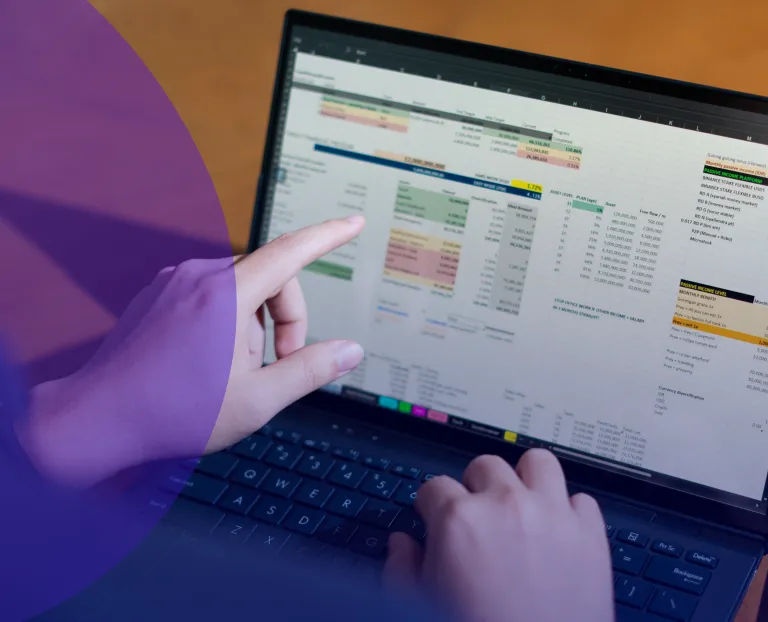
The Hidden Costs of Spreadsheet-Based Due Diligence
For decades, spreadsheets have been the default tool for operational due diligence. But the costs of this approach are becoming impossible to ignore.
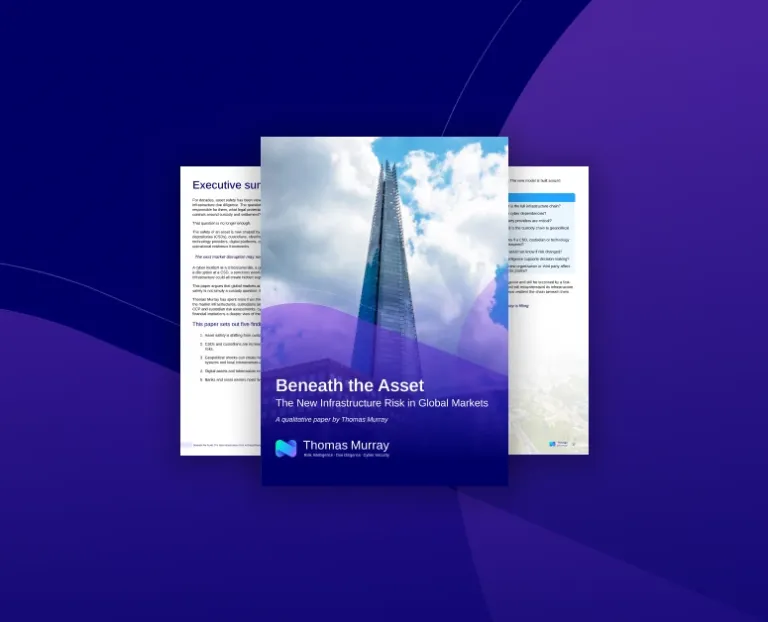
Thomas Murray Launches “Beneath the Asset” Initiative
New analysis warns the classic understanding of asset safety is being fundamentally reshaped.

Missing Security Provisions: 10 Key Questions every Private Equity firm should ask their MSP
Most private equity firms assume their MSP is handling cyber security. Most are wrong.