

Information current as of 22 January 2026
BNY Extends Digital Cash Capabilities for Institutional Clients
BNY has announced that it is extending its digital cash capabilities for institutional clients. This capability marks a step forward in their ambition to tokenise bank deposits for real-time, on-chain settlement between industry participants.
Tokenised deposits can help to reduce settlement friction, improve liquidity efficiency across collateral and margin workflows, and enable programmable payments and settlements.
Key takeaways
- This is the first step in BNY’s strategy to tokenise deposits by enabling the onchain mirrored representation of client deposit balances on its Digital Assets platform.
- This launch helps to advance BNY’s ambitions to support programmable, onchain cash for institutional market infrastructure.
- Early participants include a wide range of prominent financial institutions and digital natives.
More information can be found here.
State Street Launches Digital Asset Platform
State Street has announced the launch of its Digital Asset Platform, a secure, scalable infrastructure for tokenised assets, strategically positioning State Street to be a bridge between traditional and digital finance and the connection point between digital asset platforms for its clients.
This foundational build is critical in enabling State Street’s digital ambitions to develop core products for its clients, including tokenised Money Market Funds (MMFs), ETFs, tokenised assets, and cash products, including tokenised deposits and stablecoins.
The platform includes wallet management, custodial, and cash capabilities designed to support tokenised product development across jurisdictions, covering both private and public permissioned blockchain networks.
LSEG Launches Blockchain-Based Digital Settlement House
LSEG has announced the launch of its new digital settlement service, Digital Settlement House (LSEG DiSH). This open-access platform enables programmatic and instantaneous settlement between independent payment networks, both on and off chain.
Through commercial bank deposits held on the DiSH ledger (DiSH Cash), the service will enable the 24/7 instantaneous movement of commercial bank money in multiple currencies and jurisdictions, Payment versus Payment (PvP) and Delivery versus Payment (DvP), providing a real cash leg for FX and digital asset transactions and settlements. Market participants will be able to conduct PvP or DvP and settlements using any asset, orchestrating payments on any connected network, digital and traditional.
Swift Takes Steps to Unlock the Benefits of Digital Finance on a Global Scale
Swift, in collaboration with BNP Paribas Securities Services, Intesa Sanpaolo and Societe Generale – FORGE, has completed a landmark digital asset interoperability trial, marking an important step in its efforts to drive a new era of global interoperability. The trial enabled the seamless exchange and settlement of tokenised bonds, while supporting payments in both fiat and digital currencies.
The initiative focused on key processes such as delivery-versus-payment (DvP) settlement, interest payouts and redemption of tokenised bonds with roles including paying agent, custodian and registrar. This marks the first time Swift has demonstrated its ability to orchestrate tokenised asset transactions as a single, coordinated process across both blockchain platforms and traditional systems.
FINMA Publishes Guidance on Custody of Crypto-Based Assets
The Swiss Financial Market Supervisory Authority, FINMA, has issued new guidance explaining how it assesses the risks associated with the custody of crypto-based assets. The guidance sets out the rules that institutions must abide by in order to keep crypto-based assets safe.
FINMA is seeing increasing interest in crypto-based assets and related services in the Swiss financial market, with more and more customers wanting to trade, invest and securely store cryptocurrencies - FINMA-supervised institutions have therefore expanded their offering in these areas.
In its new guidance, FINMA draws attention to the particular risks associated with the safekeeping of crypto-based assets, such as bitcoin or ether, which arise because of the associated technology (distributed ledgers). It recommends that expertise and a robust technical infrastructure are therefore needed to mitigate these risks.
Wyoming Becomes First US State to Issue Stablecoin
Announced by Governor Mark Gordon, the US State of Wyoming has launched the first fiat-backed, fully reserved stablecoin to be issued by a public entity in the United States.
Gordon, chairman of the seven-member Wyoming Stable Token Commission, lauded the innovative foresight of state legislators for “working nearly a decade to set the foundational legislation to make this venture possible.”
The Frontier Stable Token (FRNT) is now publicly available on Kraken, a Wyoming-domiciled cryptocurrency exchange and Special Purpose Depository Institution (SPDI). Users can purchase the stablecoin on the Solana blockchain, and transfer to additional blockchains using the Stargate platform. FRNT is currently supported on the Arbitrum, Avalanche, Base, Ethereum, Optimism, Polygon, and Solana blockchains.
J.P. Morgan Expands Digital Deposit Coin to Canton Network
Digital Asset and Kinexys by J.P. Morgan, the firm's blockchain business unit, have announced their intention to collaborate on the native issuance of Kinexys by J.P. Morgan's deposit token product, JPM Coin (JPMD), on the Canton Network, a privacy-enabled blockchain network designed for synchronised financial markets.
JPM Coin by Kinexys Digital Payments is the first bank-issued USD-denominated deposit token and provides institutional clients with the ability to make payments using a digital representation of J.P. Morgan’s USD deposits on a public distributed ledger. This innovation helps meet the growing demand from both digitally native and traditional firms seeking faster, easier, and more secure money movement on public blockchain infrastructure.
In bringing JPM Coin natively to Canton, Digital Asset and Kinexys by J.P. Morgan are laying the foundation for regulated, interoperable digital money that can move seamlessly across financial markets.
Standard Chartered to Launch Crypto Prime Brokerage Under Venture Capital Arm
Standard Chartered is preparing to deepen its push into digital assets by setting up a crypto prime brokerage, according to people familiar with the matter, as major global banks accelerate efforts to compete for institutional crypto flows.
The London-based global financial institution and lender plans to house the new business within SC Ventures, its wholly owned venture capital arm (which created Zodia Custody), rather than inside its core corporate and investment bank.
Discussions remain at an early stage, and the timing of any launch has yet to be determined.
Ripple Expands European Regulatory Footprint with Preliminary EMI Approval in Luxembourg
Ripple has announced that it has secured preliminary approval of its Electronic Money Institution (EMI) license from Luxembourg's Commission de Surveillance du Secteur Financier (CSSF). This license represents a significant step in Ripple's efforts to scale its cross-border payments infrastructure across Europe, and to support institutions there as they move from legacy technology to real-time, 24/7 payments.
This news comes after another recent announcement that Ripple has been granted its EMI licence and Cryptoasset Registration by the UK’s Financial Conduct Authority (FCA). These new licences from the EU and UK will add to Ripple's portfolio of more than 75 regulatory licences around the world, making it one of the most licensed crypto companies in the world.
CME Group to Expand Crypto Derivatives Suite with Launch of Cardano, Chainlink and Stellar Futures
CME Group, the world's leading derivatives marketplace, has announced plans to expand its leading suite of regulated cryptocurrency derivatives with the launch of Cardano (ADA), Chainlink (LINK) and Stellar (Lumens) futures on 9 February 2026, pending regulatory review.
Market participants will have the choice to trade both micro-sized and larger-sized contracts:
- ADA futures (100,000 ADA) and Micro ADA futures (10,000 ADA).
- LINK futures (5,000 LINK) and Micro LINK futures (250 LINK).
- Lumens futures (250,000 Lumens) and Micro Lumens futures (12,500 Lumens).
"Given crypto's record growth over the last year, clients are looking for trusted, regulated products to manage price risk as well as additional tools to gain exposure to this dynamic market," said Giovanni Vicioso, CME Group Global Head of Cryptocurrency Products. "With these new micro- and larger-size Cardano, Chainlink and Stellar futures contracts, market participants will now have greater choice with enhanced flexibility and more capital-efficiencies."

Digital Asset Custodian Monitoring
Our DACM solution sets a standard for transparency and risk intelligence in digital markets. Against an industry that is complex, fragmented, unstandardised, and fraught with cyber risk, our solution provides you with the tools and insights to effectively evaluate, select and monitor your digital asset custodian.
Insights

Why Cyber Risk Belongs in Operational Due Diligence
Cyber risk is still treated as an IT checkbox in operational due diligence. Here's why it needs to be a continuous monitoring signal.
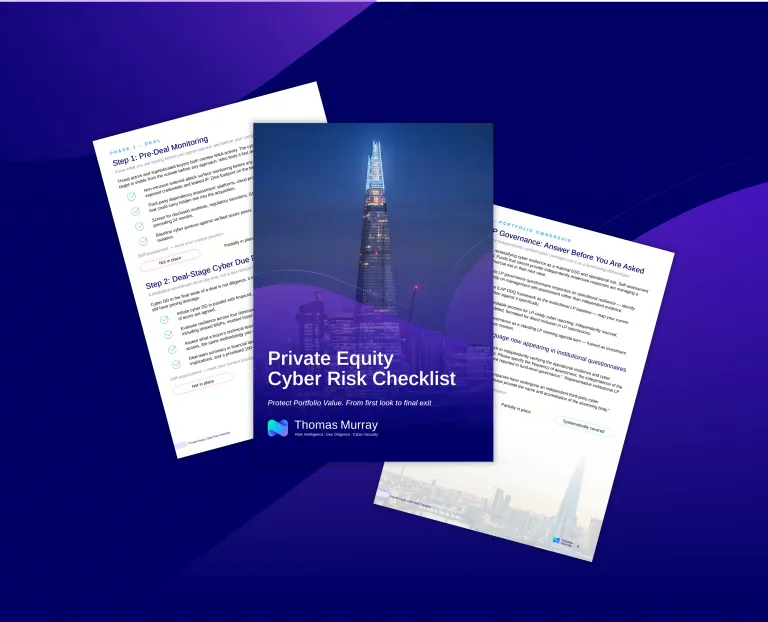
Private Equity Cyber Risk Checklist
The PE Cyber Risk Checklist is a ten-step diagnostic for PE fund leadership, covering every stage from pre-deal surveillance to exit readiness.

Why Private Equity Has Underinvested in Asset Safety, and Why the Window Is Closing
Half of PE portfolio companies carry elevated cybersecurity risk. Here's why asset safety has been underinvested, and why that's changing fast.

ODD Is More Than Questionnaires
Most investors and allocators would struggle to name the last time a due diligence questionnaire predicted a fund manager's operational failure.